I could not possibly do justice to my first visit a half hour south of home to the Missouri Capitol Building in Jefferson City yesterday. But I will go back and have a better idea of what I am seeing and what to not miss on future visits.
Our first stop was an overlook above the wide Missouri, this first day of February populated by ice pancakes slowly spinning as they moved along at a fast walking pace towards the Mississippi another 140 miles downstream.
The Senator Roy Blount Bridge is one of the increasingly-rare trussed-arch forms being replaced by structures that are easier to build and maintain. More efficient is not always more pleasing to the eye.
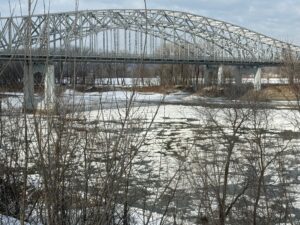
The Missouri River no longer hosts steamboats or even barges, having mostly become a domesticated drainage free of historical flow or prior purpose. Channelized and shortened by several hundred miles over its course, the domesticated artery no longer serves in the historical role of a river, trading an increase in hydraulic efficiency against the loss of floodplain agriculture, and meandering sandbar-wetland natural populations.
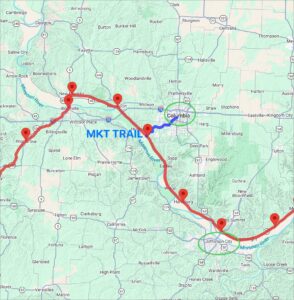
The coming of the railroads supplanted the slower and more risky water access to the interior of the country as the young nation of the 1800s moved west. The old railroad bed along the river corridor now hosts a portion of the 239 mile Katy Trail Bike Path that can be reached via a connecting stretch (The MKT in blue) from a few miles northwest of me in Columbia. It follows the old railroad bed along the base of the bluffs along the river in Jeff City.
I imagined Misters Lewis and Clark poling up the river, glancing over at brightly clad clots of bikers having lunch on the banks, waving them north.
The Capitol Edifice
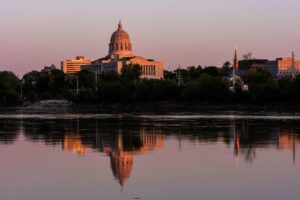
Again, there is just too much visual overwhelm to tell what you can see and learn from this place. Here is the river view (WikiMedia) followed by statuary near the entry doors.
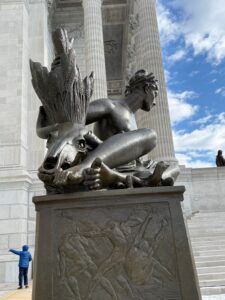
We had not even gotten inside before the architecture amazed us. We were greeted by this 1400 pound statue of Ceres, the goddess of grain (highlighting the states historic strengths in agriculture). She was approachable at ground level on our visit, but has been perched on the very top of the capitol dome most of the time since installation in 1924.
I can’t explain the Fight Club images on the pedestal but I thought they all should have sweatshirts, including Ceres. It was COLD!
Struck by lightning 300 times, the goddess needed a vacation make-over before regaining her high perch in 2019, but now obviously she’s comeback down to Earth again and is easier to get to know.
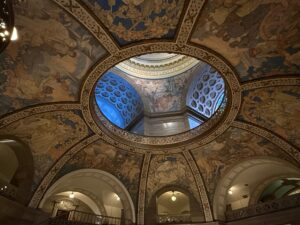
The capitol building was burned in 1837 and again in 1911 and rebuilt. And was it ever made over! Artistry and story is present everywhere you look, surrounded by historical drama that will bring us back again at least a few times to take it in.
“The building’s decoration is almost its own “second phase” of history: a surplus from a special property tax earmarked for the Capitol had to be spent on the building, so a commission used it to recruit prominent artists and fill the Capitol with murals, sculpture, stained glass, and carvings.”
And so there is a LOT to see, and much of the building is freely open to the public and you can roam all four floors until closing time.
Finally: FOSSILS
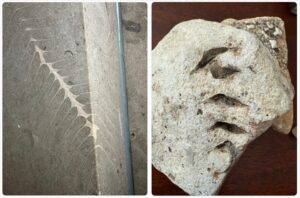
One of the features most tourists to the capitol building miss is the presence of fossils in the Missouri limestone interior wall panels. There is a brochure to guide you to them if you don’t happen to be with companions who know their way to locate them in the walls or floor panels. We knew such people.
So to wrap this up, two images side by side: first from the architecture, the foot-long embedded calcareous “stem” upon which the lacy “fronds” of this early Bryozoan were arranged; and second, one of the creek fossils I found last summer that puzzled me for months. Turns out it was the screw-shaped central stem of Archimedes pressed into limestone that I had mistaken for tooth marks.
Go here to get an idea of what the creature looked like in the ocean that, a few hundred million years ago, would have submerged me at my desk in what is now Missouri on what is now North America.
Leaving Home to Find It
So here after 16 months of life in Missouri, I am extending my sense of place, with the help of my friends.
The river is such a big part of the history of Boone County and I can learn much with a little investment of time and curiosity.
There will likely be more travel tales in the coming year. Or years. One never knows at this stage. But so far, I have my health and much to be grateful for—including you fellow sojourners out there who join me from time to time. Thank you for riding along.
 – Fred First is an author, naturalist, photographer watching Nature under siege since the first Earth Day. Cautiously hopeful. Writing to think it through. Thanks for joining me. Subscribe to My Substack HERE.