Being elderly is a full-time job. It could be the best job you ever had, but it will never be the easiest. Even Billy Graham, the preeminent spiritual leader of America for six decades, said in his book Nearing Home, “old age is not for Sissies.”
We have been married over 72 years. In several months, if God chooses, Dottie will be 92, and I will be 95. Ten years ago, we moved to a smaller home, had our wills legally completed, and I retired.
Although our children had their reasonable doubts, they accepted our plan to “shelter in place.” We are not sheltering from an “active shooter.” We are sheltering in our own home, where we feel secure.
We could not succeed without the loving care generously provided by Clinton (musician), Bobby (physician), and Nancy (reading teacher). Our son David is an attorney on another continent. He maintains a loving relationship with us from many miles away. God has richly blessed us with His irreplaceable gifts of the children we love beyond the telling of it.
We are thankful for the blessings of life itself, and for countless more, especially for family, friends, and dear neighbors. I suspect we are like most other elderly people; we spend a lot of time in medical appointments. We depend mostly on Clinton to drive us.
We live in a period of challenging cultural change. The change is occurring more rapidly and more radically than any other. Media, too often in the hands of Postmodern Deconstructionists, markedly influences more lives than ever before. These antiauthoritarians ignore history and reject widely accepted morality. They are hell-bent on finding and creating flaws in previously recognized American heroes, and they angrily mock American loyalty.
A less visible change in health care is quietly shifting the responsibility for health from physicians to patients.
Lifestyle diseases cause the most mortality. The public is being educated on how to take better care of themselves. Even when fully aware of self-destructive behavior, many people fail to make behavioral changes that are essential to maintaining good health. A significant shortage of physicians has modified the all-important doctor-patient relationship. Sadly, the doctors’ interest is focused more on disease than the patient, and more on the computer entry than on examining the patient.
Aging poetically is an intentional way to view our later years. For example, they count their blessings instead of emphasizing their complaints. In the words of the old hymn, “Count your blessings; name them one by one and it will surprise you what the Lord has done.”
Aging Poetically focuses on maintaining physical, mental, and spiritual health. Dr. Anthony Fisher is a good man, a good doctor, and has become as important to us as a member of our family. Father Dan Malcolm, All Saints Anglian Church, Charlottesville, along with our dear friend since he and I were fellow students at Maury High School, Bobby Trent, bring Holy Communion to our home monthly owing to our physical limitations.
Aging poetically means accident prevention. In 2023, falls resulted in the deaths of over 41,000 Americans aged 65 and above, marking them the top cause of injury-related mortality for seniors. The number of fatalities has increased sharply, and each year, more than 3 million people from this age group visit emergency departments due to injuries from falls.
No matter how short the distance, never walk with something in both hands. If you rely on a walking stick, acane, or a walker, they are intended to help you take every step. Use it occasionally to invite injury or death! Have a plan for getting up after a fall. Practice your plan. Many dangerous falls occur while getting in and out of bathtubs and showers.
“Transition” is the term used to describe changing from sitting to standing, standing to lying down, and so forth. It is during transitioning that we old poets are most vulnerable to accidents. Our son Clinton found and installed the “Stander Wonder Pole, Security-Pole and Curve Grab Bar, Tension Mounted Floor to Ceiling Transfer-Pole for Seniors, Elderly Adults, Bathroom Safety Assist and Stability Rail.”
We have one of these safety poles by the shower door, commode, and bed. Honestly, I don’t know what would have happened to us without them. They are easily found on Amazon or Google. I wish I owned stock in the company that makes them.
Elderly persons willing to try to age poetically, pioneers just as I am, will find it takes time, effort, and patience by the truckloads. We can change our “got to” to “glad to,” with a pleasant smile.
Several decades ago, my favorite cousin, a nurse married to Paul, a Church of God minister, died during a church service.
Dottie and I attended the funeral service. After the funeral, Paul asked us to come to his home. “It would mean a lot to me,” Paul said. I replied, “I’ve got to get back to Charlottesville.” It was a harsh, cold, uncaring reply; it was significant because it is a strong memory. Today, if I am truly aging poetically, I would smile warmly, replying to Paul, “I would be glad to.”
Life is movement. The less we move, the less we live. Any exercise is better than none. Talk to your physician before exercising: “Doctor, how much exercise do you get, and what is BDNF?”
If your good doctor is simply too busy to exercise, seize the opportunity to tell how exercise is essential to good cognitive, cardiac, and psychological health. Urge him to read about BDNF (Brain-Derived Neurotropic Factor). If a person exercises on a regular basis, it causes the release of BDNF; the BDNF converts stem cells in the brain to neurons (brain cells) that migrate to the hippocampus, where emotional memories are stored. If he or she does not thank you profusely, ask for a refund.
Ben Sasse resigned from the U.S. Senate in January 2023 to lead the University of Florida, then stepped down from that role in July 2024 due to his wife’s health. In December 2025, he announced a diagnosis of terminal pancreatic cancer.
Ben Sasse’s cancer had spread widely. He died several days ago, but in a recent interview, Sasse reminded us, “You can play a lot of basketball in the last 60 seconds.” He apologized to his wife and children for the time he spent on his career and not with them. His faith in Jesus Christ, the only “begotten Son of God,” strengthened his soul despite the shimmer of pain in his body.
Yes, aging poetically is living and dying with faith in a God whose love for us was so great that He gave his son to die for our sinful nature. Christianity is all about love.
Aging poetically is aging with sincere love. No one can age without blemishes. We are not expected to be perfect and must repent and seek forgiveness when we fail and when we do wrong.
Those of us who watched the Ben Sasse interview were deeply touched by the physical pain he was bravely enduring, the courage with which his death was soon to come, and his faith in the power of Almighty God, in whose arms he submitted himself to be gently taken from his family to the Presence of God.
Ben Sasse concluded the interview by reading from In Memoriam by Alfred, Lord Tennyson (1803-1892):
Ring out, wild bells, to the wild sky,
The flying cloud, the frosty light:
The year is dying in the night;
Ring out, wild bells, and let him die.
Ring out the old, ring in the new,
Ring, happy bells, across the snow:
The year is going, let him go;
Ring out the false, ring in the true.
Ring out the grief that saps the mind
For those that here we see no more;
Ring out the feud of rich and poor,
Ring in redress to all mankind.
Ring out a slowly dying cause,
And ancient forms of party strife;
Ring in the nobler modes of life,
With sweeter manners, purer laws.
Ring out the want, the care, the sin,
The faithless coldness of the times;
Ring out, ring out my mournful rhymes,
But ring the fuller minstrel in.
Ring out false pride in place and blood,
The civic slander and the spite;
Ring in the love of truth and right,
Ring in the common love of good.
Ring out old shapes of foul disease;
Ring out the narrowing lust of gold;
Ring out the thousand wars of old,
Ring in the thousand years of peace.
Ring in the valiant man and free,
The larger heart, the kindlier hand;
Ring out the darkness of the land,
Ring in the Christ that is to be.
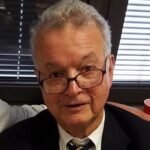
Robert S. Brown, MD, PHD a retired Psychiatrist, Col (Ret) U.S. Army Medical Corps devoted the last decade of his career to treating soldiers at Fort Lee redeploying from combat. He was a Clinical Professor of Psychiatry and Professor of Education at UVA. His renowned Mental Health course taught the value of exercise for a sound mind.