For many years, the Hon. B. Waugh Crigler, a former federal magistrate, taught the Men’s Bible Study in Charlottesville. It became an online Zoom Bible Study, available to both men and women, and now taught by Stuart Revercomb following the Waughs’ untimely death.
The class meets on Fridays at 7 AM. The John Stacey Hour, also called the “After Hour,” is akin to group therapy where a smaller group shares what is on their heart, and Christian love abounds.
A decade ago, Waugh surprised me by saying, “The multitude of heavenly hosts who appeared to the shepherds the night of Jesus’ birth numbered in the thousands. Composed of angelic warriors, both seen and unseen, “Praising God and saying: Glory to God in the highest, and on earth peace, good will toward men!”
It was a novel, important thought that stuck in my mind. I became a Christian when I was 12, more than 82 years ago. I love the biblical, detailed description of the birth of Jesus. Over the years, we read the account in the book of Luke as a family tradition. Each person read a verse or two. How could I have missed the significance, spiritually and numerically, of the appearance of “a multitude of the Heavenly Host” until now? I’m relieved that the shepherds were frightened. I tend to fall on the frightened scale when awed by the Glory of God and by the Holy Spirit.
Every Christmas, Dottie and I, and our children, some willing, always went Christmas caroling in our neighborhood. We rely on walkers now, making caroling too challenging. My point: I love Christmas carols, sang them joyously, but I confess, I hardly paid much attention to the theological truth they so well convey.
Charles Wesley composed “The Herald Angels Sing” in 1739, and it was subsequently edited by George Whitefield. William H. Cummings set it to music using a tune by Felix Mendelssohn in 1855, making it the popular carol recognized today.
Hark! the herald angels sing:
“Glory to the newborn King!
Peace on earth and mercy mild
God and sinners reconciled.”
Joyful, all ye nations rise
Join the triumph of the skies
With angelic hosts proclaim:
“Christ is born in Bethlehem.”
Hark! the herald angels sing:
“Glory to the newborn King!”
Luke, author of the third gospel, patron saint of physicians, trained in taking detailed histories, masterfully describes the birth of Jesus:
8 Now there were in the same country shepherds living out in the fields, keeping watch over their flock by night. 9 And behold, an angel of the Lord stood before them, and the glory of the Lord shone around them, and they were greatly afraid. 10 Then the angel said to them, “Do not be afraid, for behold, I bring you good tidings of great joy which will be to all people. 11 For there is born to you this day in the city of David a Savior, who is Christ the Lord. 12 And this will be the sign to you: You will find a Babe wrapped in swaddling clothes, lying in a manger.” Luke 2:8-12, NKJV.
Immediately, a multitude of Heavenly Host started praising God!
“No other king anywhere in the world was lying in a feeding trough (manger). Find him, and you find the King of kings. And you will know something utterly crucial about his kingship.” John Piper.
In this morning’s Bible Class, I learned amazing biblical truths. A multitude of the Heavenly Host, for example, appeared only to the shepherds, announcing the birth of Jesus. When Jesus returns to earth, everyone will see a multitude of Heavenly Host.
These were special shepherds. Their assignment was important to the Hebrew faith. These men were more like rabbinical associates charged with rearing sheep fit for Jewish ritual sacrifices. After each newborn calf was examined and found without flaws, its legs were wrapped in “swaddling” clothes, and placed in a manager.
In the Bible, swaddling clothes were strips of cloth used to wrap newborns for comfort and warmth, as when Mary wrapped Jesus (Luke 2:7, 12). These cloths carry symbolic meaning: they foreshadow Jesus’s burial, highlight His humility as the “Lamb of God,” and underscore His humanity.
Mangers are found where cattle and other animals are fed. They are usually made of roughhewn logs and are of no consequence except when grass or hay are unavailable. Jesus identified himself as “the bread of life.” And Jesus said to them, “I am the bread of life. He who comes to Me shall never hunger, and he who believes in Me shall never thirst.” John 6:35, NKJV. It is His “bread of life” we take into ourselves during communion after we confess our wrongs.
The angel told the shepherds, and all who accept Jesus as their redeemer, that we have no reason to fear; we have been given the cause of great joy for all people.
The term “Heavenly Host” refers to the immense and powerful assembly of angels and spiritual beings that serve and worship God in heaven. In religious texts, especially within Judeo-Christian theology, the Heavenly Host is often depicted as an organized, innumerable army of celestial beings who function as messengers, warriors, and worshippers in the divine realm.
Among the blessings for which I give thanks during the season of giving is God’s love for us. He loves us no matter how our thoughts, feelings, and behavior may disappoint the One who gave His life for us.
Jesus was born in a stable, wrapped in strips of cloth, placed in a feeding trough for animals, and took the punishment for our sins on the cross at Golgotha.
The image of a multitude of the Heavenly Host serves to remind believers of the grandeur, order, and sovereignty of the divine. It reassures us that God is accompanied by powerful, faithful servants who enact his will and offer unceasing worship.
May you feel the Christmas angel’s promise of “great joy,” and have in your heart and daily life the words of a multitude of Heavenly Host:
“Glory to God in the highest, and on earth peace, goodwill toward men.”
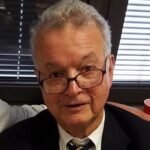
Robert S. Brown, MD, PHD a retired Psychiatrist, Col (Ret) U.S. Army Medical Corps devoted the last decade of his career to treating soldiers at Fort Lee redeploying from combat. He was a Clinical Professor of Psychiatry and Professor of Education at UVA. His renowned Mental Health course taught the value of exercise for a sound mind.