This is an excerpt from a continuing story of finding home. Much comes before; and chapters remain in this life, for how many more seasons? Recently a magnificent mature male bald eagle surprised me as he flew low and landed a short way from the car on a country road here in Boone County, Missouri. That prompted me to revisit this time in my life—800 miles and a quarter century from here and now.
In this account from real life, desperation gave way to expectation. And I still expect and accept these omens of hope. And I still long for home and am finding small fragments of it, even yet.
The tiny cabin where I lived alone that year was surrounded by dark forest. Trees there were stark and bare, their bonsaied branches witness to the cost of living on a mountaintop in the unrelenting north wind. Winter’s monochrome already paled the mountainsides where only weeks before the brilliant colors of autumn had been dazzling.
Almost all of my neighbors on Walnut Knob were seasonal. They left for good when cold weather came; the crowds of leaf-lookers wouldn’t be back up for another year. I rarely saw anyone else as I drove the windswept Blue Ridge Parkway to and from work. As days grew shorter and darker, solitude devolved toward loneliness.
At the end of a week of cold drizzle and rain, the endless fog yielded to a frigid and unrelenting arctic gale. I stood at the window of the cabin that late fall Saturday morning, the wind pulling at the panes, drawing the heat away faster than the wood stove could make it. Over the roof and across the yard brown leaves blew, out over the sad gray bones of fruit trees huddled inside the garden fence.
Wind harbors a pernicious misery all its own. You can dress against the cold, but there are days when you can’t hold out the wind that blows cold to the bone and bears down on the spirit. Like a prisoner trapped indoors by the wind, I was forced to consider my weekend sentence. These two barren days were merely a foretaste of the short days and long long nights of winter’s coming judgment. The walls of my cell sucked life from me. By mid-day, the confinement was a worse misery than the wind.
Dressed as if I would walk on the moon, I pushed out of the front door, into a hostile world. With my first breath, the wind hurled ice crystals that stung my cheeks like needles; it forced the icy air back into my lungs before I took my first step; before I could find the lee side of the cabin.
There, protected by the house behind me and the deck above, I was sheltered from the abrasive wind’s full force while I split kindling that I didn’t really need. But the wind found me even there; eddies of the freezing gale licked over the roof and spilled like a cold liquid into my gloves and down my neck under the old plaid scarf.
The cold and the wind together conspired to undo me, but the heft of the axe and sharp resolve of a clean split brought me back to the necessity of keeping warm. Firewood gave me purpose. The busier my hands became, the less my mind settled into self-pity. As I fell into the rhythm of the chore, my muscles warmed and my pulse quickened.
But then, out of that vast impersonal sea of cold that raced south from the tundra, one pernicious tendril of air licked down and found the scarf. It lifted up the smell of the cedar from our closet back home—what used to be home. The scent filled my memory like a thing alive—the comfortable, reassuring aroma of a safe place I had abandoned forever. This fragrantly brutal truth transported me to a place where I had once belonged.
Could that have been my life only a few months before? Peace and security and warmth wafted from those aromatic dark lost places—a memory that warned of the loneliness ahead. Under that scarf at my throat a sob swelled, lifted and left on the wind, tumbling down over the garden fence, south, toward Carolina.
So. I was not a rock that feels no pain. For almost five months I had pretended for Ann’s sake that I was. I felt that I had to make it seem I was not deterred by the strains we were under, that I had no serious concern with the loss we had brought on ourselves, no fear of the risks that lay ahead.
She had so many of her own crosses to bear, and she, too, was alone with them a hundred miles away. But my self-delusion was shattered that morning, by that whiff of cedar—such a small thing, a few molecules in the memory of a moment that made me wonder. What had we done? Where were we headed?
Though the timing brought many hardships—including the year of living apart—many things had in fact worked out for good. Doors opened in auspicious ways that seemed to show it was ordained we should go to Virginia for the next chapter in our lives—perhaps the permanent, happy last chapter.
After waiting for almost two years for the physical therapy position to open in Floyd County, I had been called with the job offer. We found the cabin on the Parkway that matched our needs and our budget.
The big house in Carolina sold in a week at our asking price and Ann found reasonable if not ideal housing nearby. So much had fallen into place. Now, five months later, we were both living alone. I was in a flimsy modular mountain home and she in a single-bedroom upstairs apartment in downtown Morganton, a half block from the perpetual wail of fire engines and the sound of breaking glass in the alleyway just under her window.
We were three hours apart and there were stretches when it was many weeks between our visits, split between the uncomfortable hospitality of “my place” or “her place”. We were not at home in either.
We found small comfort in each other’s occasional company. Ann’s pharmacy studies were difficult. They took every bit of her energy and attention away from me—with the exception of those tense moments face to face or over the phone when we wrestled with the Gordian knots our family affairs had become.
Both of our children had moved to new towns far away. Suddenly our nest was empty—and not only because our children no longer lived at home. Neither did we.
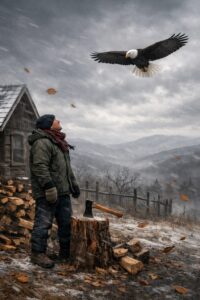
Bewildered, I buried the blade of the axe into the tough locust of my chopping block and stepped out to the edge of the terrace, empty and unsure. The yard sloped away down past the garden into forest and the forest fell away, on and on until the woods became a gray abstraction against an empty sky. I scanned the faint line between cloud and mountain as if I might find an answer out there, a clue to explain what was to happen to us now.
Just then, the wind blew back the hood of my parka and I was no longer under its shadow but under sky. Maybe it was this —that made me, at just that instant, look up.
On a bleak morning when apparitions of past and future had come and gone like scenes in an endless bad dream, at first I doubted my eyes. Maybe this too was a wraith, a mirage. Above me barely higher than the roof of the cabin, an adult male Bald Eagle floated motionless as if painted on a canvas of low clouds. Every feather was distinct, sharp-edged. His powerful beak parted the wind like the prow of a ship against strong current.
Facing into the gale, the massive bird did not move, neither forward or back. He turned his head slightly and looked down at me with one piercing-cold yellow eye, as if he had known that I would look up. Maybe he had been there watching all along, from the moment that the smell of cedar had made me admit my true helplessness and fear. I will never know.
I do know that the overshadowing of those wings at that moment was my burning bush. This was my sign, this bird that hovered above me like an angel, motionless while the wind lifted him, held him up. This was my messenger come to proclaim that, while there would be strong winds in days ahead that would make us pull inside ourselves unsure of tomorrow, we would stay the course, face the hard times, and make our way forward.
The eagle hung there until the winds slackened and he could move on, into that force that both opposed and lifted him. He came unpinned from the sky, soared out of the painted canvas of heaven, and moved on. He was heading north.
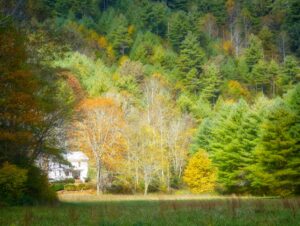
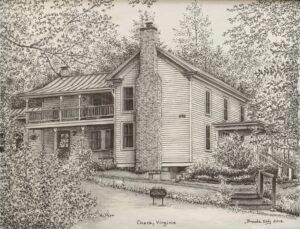
Ann and I made our peace with the uncertainties. We agreed that while we would go on planning and dreaming, we would be patient, present in each day, ready when the right home place came along. She moved up to join me in the cabin in the fall of 1998. Six months later we were working to restore the old home place here on Goose Creek. Two years almost to the day after the eagle appeared, we spent our first night in our refurbished farmhouse on a plot of land we now call HeresHome.
In late November on the anniversary of the day of the eagle, we climb to the rim of our valley and look down on what is now our home. It is a time of remembrance and thanksgiving, a time to look back and see the Providence that has hovered over us as we have walked haltingly and not always by faith.
We reach the summit and stand, breathing heavily, facing due south towards Walnut Knob. We remember the day that the eagle looked down on a bewildered man who did not understand then that a few miles north into the wind, he would one day find home.
 – Fred First is an author, naturalist, photographer watching Nature under siege since the first Earth Day. Cautiously hopeful. Writing to think it through. Thanks for joining me. Subscribe to My Substack HERE.