Several years ago, when Paul McCartney brought his legendary melodies to the foothills of Charlottesville, it was more than a concert. It was a reunion with a lineage of order that had shaped my own son’s creative life.
Yet, as a scholar of the human spirit, one cannot ignore the tragic arc of the Fab Four. They reached the zenith of fame, wealth, and secular influence, only to find the center could not hold.
Their eventual fragmentation—a descent into the numbness of drugs and the vapors of disjointed mysticism—proves that even the greatest earthly harmony fails if it is not anchored to something eternal.
At the end of that rainbow, they found not joy, but the exhaustion of the “private self.” As William James observed in 1902, we all eventually reach a point where our “little, convulsive selves” require a rest.
We find rest only when we surrender to the “Greater Self”—to God. In this alignment, life ceases to be a frantic performance and begins to take on what James called a “lyrical enchantment.” When we are consecrated to that Truth, we find ourselves humming the music of existence. We are unaware of the effort, because the melody is no longer ours alone to sustain.
But let us be honest: the physician is not immune to the malady. In the red clay of Albemarle County, where the roots of history run deep, I once laid the foundation of a promise I could not keep.
I dedicated a farm to God and a future to my family, only to see that vision fracture under the weight of my own “clay feet.”
When the “R1″—the patriarch—allows a lie to take root, the family, like the Beatles, begins its slow, agonizing fragmentation. We find ourselves in what Freud called the “common miseries” of life, wandering from the very Truth we claim to cherish.
If these “Pathogens of Chaos” act like a violent infection, the restoration of the soul is a far more deliberate process. As my mentor, Aaron “Tim” Beck, demonstrated, the “Cure” is not found in endless rumination.
It is found in the realignment of our perceptions with objective Truth. As Shakespeare wisely observed, “What wound did ever heal but by degrees?” This healing occurs through the architectural degrees of Truth, Order, and Charity. The ultimate antithesis to this restoration is the modern plague of Postmodern Deconstruction. It is a philosophy that offers no firm ground, only an endless, cynical questioning of authority, truth, and identity.
It is as useless as a man staring into a mirror, obsessing over every perceived flaw until his own image fragments before his eyes.
This “mirror-gazing” fixes nothing; it merely deepens the malady, fragmenting the body image of a civilization until it no longer recognizes its own soul. It is a “convulsive” obsession with the self that leaves the architecture of the spirit in ruins.
While Deconstruction leaves us wandering in a hall of broken glass, the Christian faith offers a firm stance. It provides the objective reality—the “Justice like mountains”—that allows us to look away from our own fractured reflections and toward the “Ancient of Days.” We do not find our identity by dissecting our “private selves” in a mirror of our own making; we find it by being drawn upward, away from the obsession with our own “clay feet.”
The biblical exodus offers a hauntingly precise map for this struggle. To move an estimated 2,000,000 souls toward a “Promised Land” requires an Order so absolute that even the dust of the desert must be accounted for.
Yet, their forty-year wandering was the high price of disobedience—the refusal to align their “convulsive” selves with the Divine. Our modern era is in its own desert, exhausted by the noise of its own making.
The “Cure” is beautifully described in the 19th-century hymn: “Immortal, Invisible, God Only Wise” by Walter Chalmers Smith. While we “blossom and flourish as leaves on the tree” and eventually “wither and perish,” the Divine remains “unresting, unhasting, and silent as light.” This is the “Pulley” described by George Herbert—a divine mechanism that pours out every blessing upon man but withholds “Rest,” so that our very weariness may eventually “toss us to His breast.” The “unspeakable peace” we seek—that which surpasses all human understanding—is not a political promise, but a homecoming.
It is the moment we stop our “wanting and wasting” and allow the pulley to draw us back to the Fountain of Goodness and Love. The wandering ends. The humming begins. We are finally home.
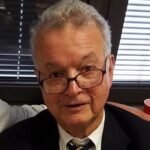
Robert S. Brown, MD, PHD a retired Psychiatrist, Col (Ret) U.S. Army Medical Corps devoted the last decade of his career to treating soldiers at Fort Lee redeploying from combat. He was a Clinical Professor of Psychiatry and Professor of Education at UVA. His renowned Mental Health course taught the value of exercise for a sound mind.