Virginia Tech has been awarded the 2026 Carnegie Elective Classification for Community Engagement, a national recognition highlighting the university’s sustained, institutionwide commitment to building trusted, reciprocal partnerships that address real world challenges locally, across the commonwealth, and around the globe.
The prestigious designation, awarded by the American Council on Education and the Carnegie Foundation for the Advancement of Teaching, recognizes institutions that deeply integrate community engagement across teaching, research, and service. Earned through a rigorous self-study process, the Carnegie classification has served for nearly two decades as the leading framework for assessing community engagement in U.S. higher education.
Virginia Tech is among 237 institutions nationwide to receive the 2026 classification. The university was first recognized in 2006, and the current designation is valid through 2032.
This recognition reflects Virginia Tech’s broad engagement ecosystem — from VT Engage: The Center for Leadership and Service Learning and its experiential opportunities for students, to faculty research partnerships addressing issues such as water quality and democratic resilience, to Virginia Cooperative Extension, with offices embedded in every county and independent city across the commonwealth.
President Tim Sands said the designation affirms engagement as a defining feature of the university’s identity.
“This recognition confirms what our communities already know — that engagement is central to who we are,” Sands said. “It also challenges us to listen even more closely, collaborating more deeply, and seek new ways to fully engage with communities we serve. We see this designation not as a finish line, but as momentum to do even more together.”
The heart of the land-grant mission
Alongside teaching and research, outreach and engagement form a cornerstone of Virginia Tech’s land-grant mission, calling on the university to share knowledge and expertise beyond its campuses to improve lives. That work spans partnerships focused on workforce development, health, education, environmental sustainability, and economic resilience.
“At its core, this work is about impact,” said Guru Ghosh, vice president for outreach and international affairs. “By partnering with communities, Virginia Tech is able to apply its knowledge in ways that matter — helping address complex challenges while preparing students to be thoughtful, engaged citizens.”
An 18-member task force appointed by the Commission on Outreach and International Affairs and led by Susan E. Short, senior associate vice president for outreach and international affairs, guided the Carnegie self-study. The group examined engagement practices, infrastructure, and partnerships across the university.
“The Carnegie process wasn’t just about earning a designation,” Short said. “It helped us better understand where we are, where we can grow, and how we can continue to strengthen community-engaged scholarship and partnerships.”
Engagement that shapes students and scholarship
Community engagement at Virginia Tech is deeply embedded in student learning and faculty scholarship. Since 2015, the number of community-engaged courses has increased by more than 300 percent, now reaching more than 15,000 students annually across 830 courses in 52 departments.
“Community engagement is where learning becomes real,” said Meghan Kuhn, director of VT Engage. “Students aren’t just applying what they learn — they’re learning alongside community partners in ways that create shared value.”
When students work alongside community partners, she said, they have the opportunity to lead and serve in real time.
“This is what community engagement is all about in a college setting — creating opportunities for students and the community to work together to create positive change. This is what we want students to learn so they can engage in their future communities and put Ut Prosim into action,” Kuhn said.
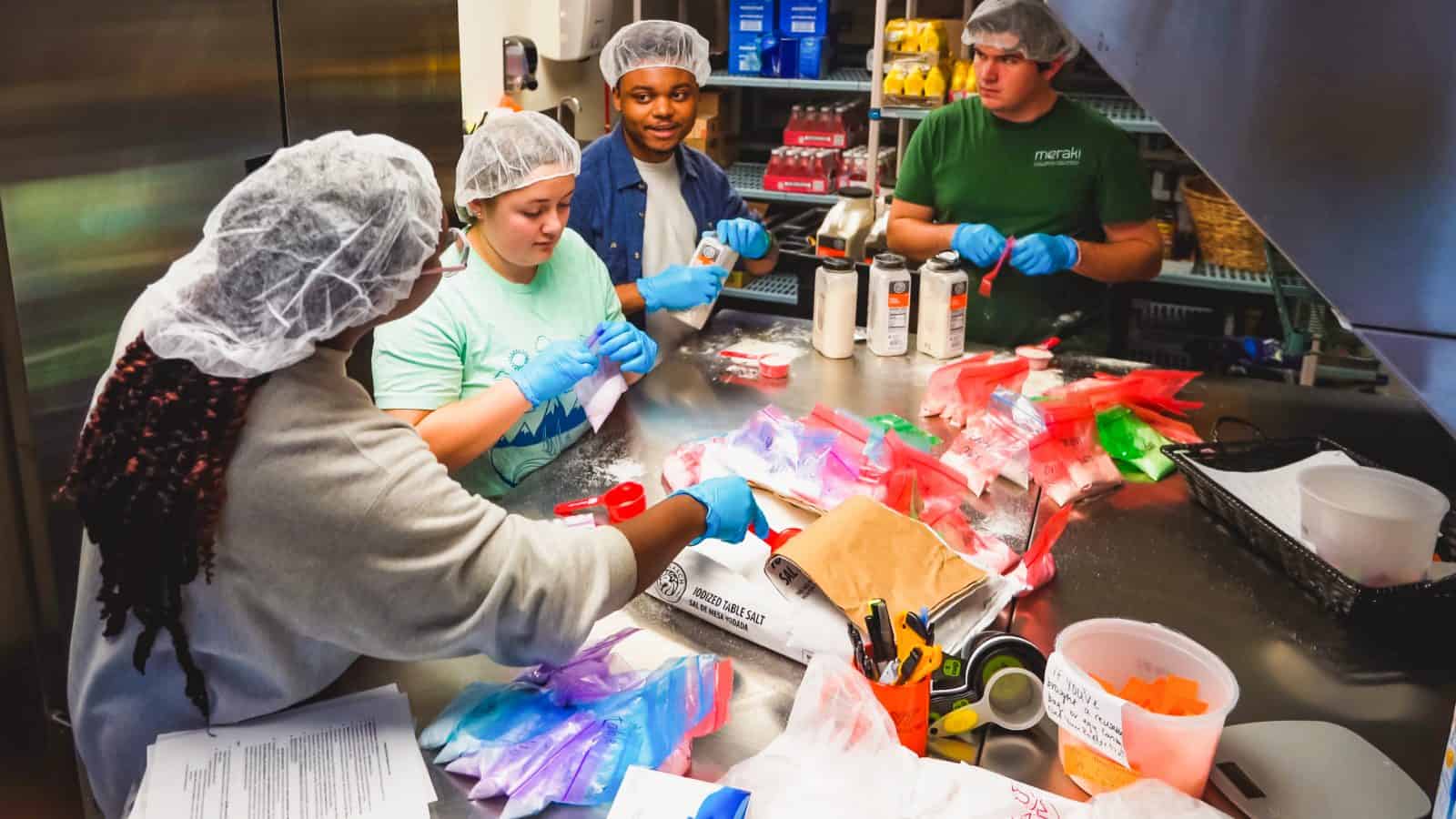
One example is The Market of Virginia Tech, a student-centered, donation-supported food access program that brings together students, faculty, and community partners to address food insecurity with dignity and care. During the 2024-25 academic year, The Market supported 829 students, recorded more than 5,700 visits, and distributed nearly 69,000 pounds of food.
Led by VT Engage and the Dean of Students Office, The Market also functions as a learning environment. Through partnerships with academic courses, students work alongside faculty, staff, and community partners to contribute to program design, communications, and assessment. Listening sessions and hands-on projects ensure services are shaped by student experience, reinforcing a model of shared knowledge creation and continuous improvement.
Community-engaged learning at Virginia Tech also extends well beyond U.S. borders. At the Steger Center for International Scholarship, for example, faculty and students collaborate with community partners in southern Switzerland on projects shaped by local priorities, from cultural heritage preservation and regional planning to environmental sustainability. These partnerships are co-designed with municipal leaders, nonprofit organizations, and regional institutions, reflecting the same principles of reciprocity and long-term relationship-building central to the Carnegie designation.
Faculty research further reflects this engagement. For instance, when Professor Angela Scarpa’s research identified limited access to autism services in rural Southwest Virginia — particularly for families facing transportation and cost barriers — her team launched the Mobile Autism Clinic, delivering diagnostic evaluations, therapy, and parent education directly to underserved communities. The initiative has received state and national recognition for its impact.

From community needs to university solutions
While many community-engaged partnerships begin in classrooms, labs, or student-led initiatives, Virginia Tech also sustains this work through long-standing systems designed to support engagement across communities throughout the commonwealth.
Virginia Cooperative Extension exemplifies that sustained, reciprocal approach. Part of the Cooperative Extension System established by the Smith-Lever Act of 1914, Extension agents are Virginia Tech faculty members who live and work in every county in the commonwealth, bringing university research to the people. Local Extension Leadership Councils, made up of community volunteers, guide programming through regular needs assessments and planning processes.
In Lancaster County, for example, these conversations surfaced priorities around shoreline preservation, agricultural innovation, and youth development. Extension agents responded by developing tailored programs, including a Shoreline Evaluation Program providing educational outreach, agricultural technology demonstrations for local farmers, and youth initiatives such as Teen Cuisine and Kids Marketplace.
“Virginia Cooperative Extension is built on long-term relationships and shared purpose,” said Mike Gutter, Extension director and associate dean of the College of Agriculture and Life Sciences. “By working side by side with local leaders, we’re able to align university expertise with community priorities and deliver solutions that are practical, trusted, and locally relevant.”
Through 4-H programs alone, more than 17,000 youth participate each year in leadership development and community service activities. Extension also coordinates more than 18,000 volunteers who contribute over 750,000 service hours annually.
Strengthening the foundation
While celebrating this designation, university leaders also point to opportunities for continued growth. The Carnegie self-study highlighted the need for more consistent definitions, tracking, and assessment of engagement across Virginia Tech.
“As a decentralized institution, we have tremendous innovation happening across the university,” Short said. “Our challenge now is building systems that help us understand the full scope of our engagement, share best practices, and better support faculty, students, and community partners.”
Efforts are underway to develop a campuswide definition of community engagement and more collaborative approaches to partner feedback and assessment — steps leaders say will strengthen trust, alignment, and long-term impact.
Learn how Virginia Tech turns knowledge into action. Subscribe to the Virginia Tech Engaged newsletter for updates on community partnerships, research, and projects that create real world impact.
By Diane Deffenbaugh