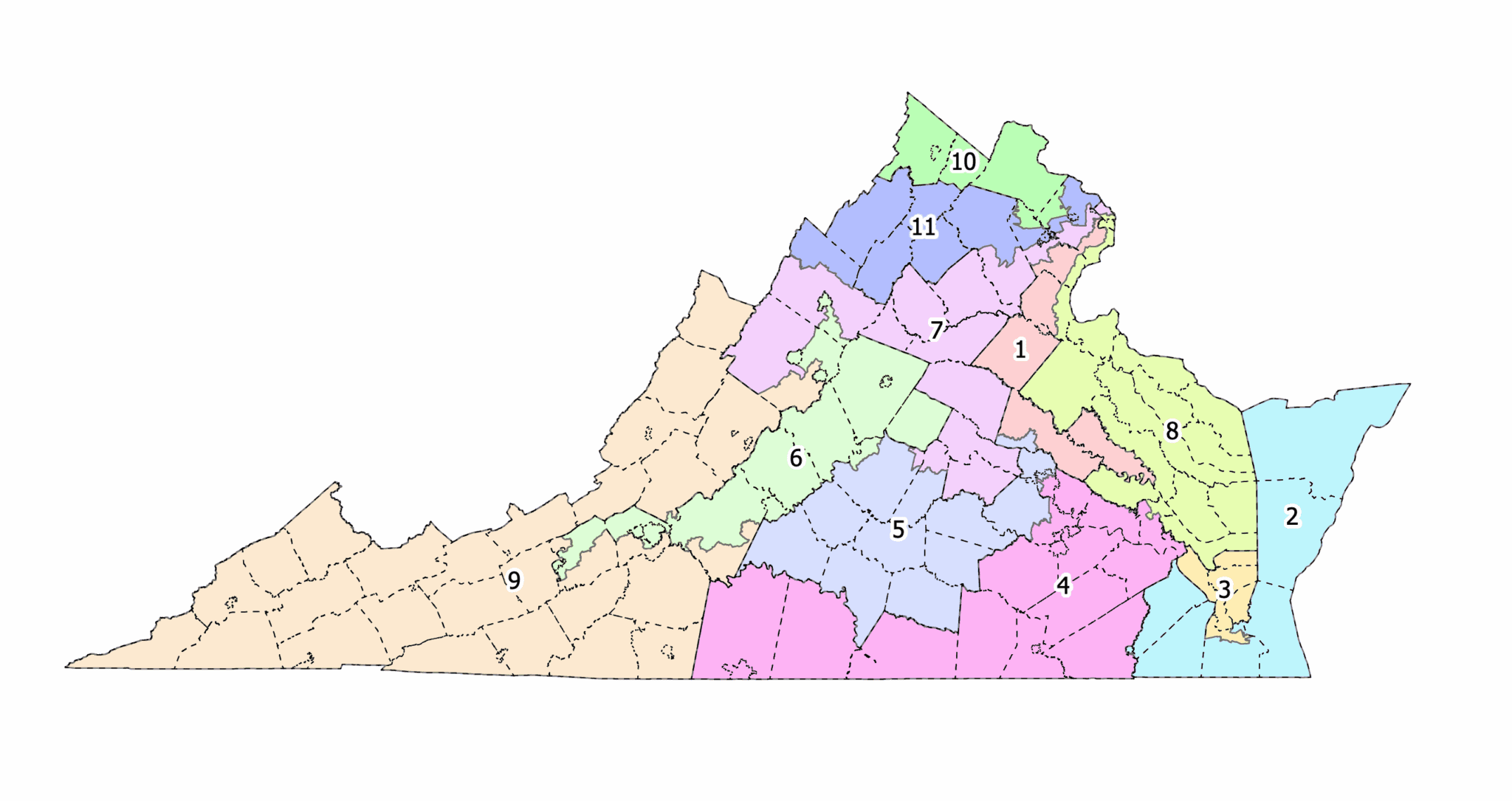
In what Cardinal News columnist Dwayne Yancey labels “sheer ugliness,” Virginia Democrats on Feb. 5 finally released their proposed new maps to carve up the Old Dominion into 11 new Congressional districts. According to the US Constitution, House seats are apportioned by population, so since Virginia has somewhat over 8 million residents, we have 11 members in the House of Representatives.
Of those current 11 seats, six are occupied by Democrats and five by Republicans. Many see this as reasonable since the Old Dominion is largely a “purple” state. For example, just one month ago, all three statewide offices were held by Republicans. Trump lost Virginia in 2024, but still carried 46.6% of the vote to Harris’ 51.8%.
However, the Democrats’ new map is projected to possibly give Democrats a 10-to-1 advantage in Congressional seats from Virginia. This was largely achieved by lumping in most GOP voters in the western third of the state into an oddly-shaped and solidly-Republican 9th District, and then most of the other ten districts were heavily gerrymandered to link Democrat-heavy areas in ways to outweigh GOP voters.
States usually draw new lines for congressional districts every ten years, after the latest census.
This year, however, Democrats are angered by the Texas legislature drawing new lines to favor Republicans in the Lone Star State. Thus, Virginia Democrats reason they must now “fight fire with fire” and redraw lines here too to offset possible Republican gains in Texas.
President Trump has repeatedly called on states with GOP legislatures to redraw their Congressional maps ahead of this year’s crucial midterm elections.
However, as some have pointed out, most conflicts arise from differences of opinion as to what “starting point” to use as the origin of the tension.
For example, Democrats cite last year’s Texas gerrymandering as their starting point. They say it’s only fair to create more safe Democrat seats here to counter-balance what the GOP has done in Texas, Florida, North Carolina, and some other Republican-led states.
In contrast, Republicans counter that gerrymandering in many Democrat states has been entrenched for decades, and Texas was merely trying to balance out those long-standing abuses from blue states.
Twitter user Zachary Werrell Esq. posted this explanation about gerrymandering, starting with California’s massive 52 seats in the House of Representatives.
“Going into this fight, Democrats in California get 58% of the vote, but their congressional maps were 43:9, or 83% democrats. Their new California maps will be 48:4, or 93% democrats.
“Illinois was 55% for democrats, but their districts are 14:3 for democrats, or 83%.
“Meanwhile, Texas was 56% for Trump, but 25:13 for their congressional seats, or 66% republicans. Their redistricting makes it 30:8, or 79% for republicans.
“Democrats in Virginia have taken a state that went 51-48% for Kamala, and redrawn a 6:5 (or 55% for democrats) and made it 10:1, or 91% democrats.
“No honest or thinking person can say the republicans are in the wrong here. As always with democrats, every accusation is an admission.”
This grossly lopsided 91% Democrat advantage in House seats from Virginia is behind the Cardinal News’ Feb. 5 headline, “A 10-1 map would give Virginia the most aggressive gerrymander of any other state.”
The Democrats released their maps and are moving to implement the new lines despite a judge in Tazewell County who recently ruled the rushed, partisan process is illegal, and even Democrat Governor Abigail Spanberger just a few years ago posted to social media how wrong gerrymandering is.
Moreover, about two-thirds of Virginia voters recently approved a state Constitutional amendment to ban political gerrymandering and instead have new lines drawn by nonpartisan officials. Thus, many view this new map as both unconstitutional and also disenfranchisement of those Virginians who voted for the amendment.
The new map, if approved, would have a huge impact on our region. The current, GOP-friendly 9th District, covering Southwest Virginia up to the Smith Mountain Lake area and represented by Rep. Morgan Griffith, would become even more Republicanby having Virginia Tech and Blacksburg stripped out of it. Thus, by compacting more Republicans into the 9th, it would dilute their influence elsewhere.
In contrast, the now-solidly Republican 6th District, currently represented by Rep. Ben Cline (R-Botetourt), would become Democrat-leaning. This would be from the new 6th District, with skinny gerrymandered lines combining the Democrat-heavy areas of Virginia Tech, Roanoke City, UVA, and JMU.
But as some have pointed out, Tech/Roanoke Democrats may not cheer for long. This is because the Democrat population around Charlottesville is much larger than here, so a new Democrat Congressman for such a 6th District would probably be from the UVA area, two hours away, making the Roanoke and New River Valleys even more unimportant politically.
Elsewhere, an incredible five districts…almost half of the state’s total…would include a narrow sliver of Democrat-heavy, densely populated Fairfax County. Those five new districts would then fan out to different corners of the state, from the Peninsula near Williamsburg (see District 8) in the east to Augusta County (see District 7) in the west.
As someone pointed out, with the new maps, one could drive just 30 minutes east to west across Fairfax County, and cross five different Congressional districts.
Due to its huge population, many envision those five Congressional seats being held by Fairfax County Democrats, while the geographically large but population-sparse parts of those districts would be largely politically powerless, being consistently outvoted by Fairfax County.
Since districts covering Southside, including Danville and Appomattox County, would include Richmond and its suburbs, it’s expected that both their Congressmen would be from Richmond.
Of course, no political lines are perfect and without detractors, but these new proposed lines violate the legal and common sense notions that political districts are to be as geographically compact as possible and also include “communities of interest.”
Democrats ran on “affordability” and “moderation” in the 2024 elections, but are now pushing the most partisan gerrymandering of any state.
The constitutionality of the new lines will soon be heard by the Virginia Supreme Court, but since a referendum is scheduled for April, and our state now has 45-day early voting, the timeline is very compressed.
A YES vote on the April referendum is to approve the new lines, while a NO vote is against them.
– Scott Dreyer