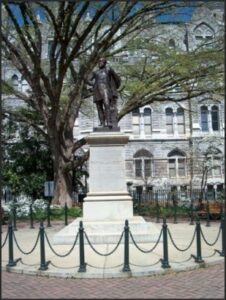
Breathtaking. Unsettling. Healing. Those meant-to-catch-your-attention words come from an article by the British newspaper The Guardian on the “reimagined” statue of Stonewall Jackson, currently on display at a contemporary “art” museum in Los Angeles.
Now, as members of The Guardian’s target audience — progressives — take full control of Virginia’s state government, is another prominent Stonewall Jackson statue in peril of being sent to the chopping block? (Literally, as we’ve seen in Los Angeles).
At the beginning of 2026, legally, the answer appeared to be: not immediately. But that has changed. Quietly, but drastically, changed.
Virginia Democrats and progressives complain constantly about the Stonewall Jackson statue that stands on the grounds of the Virginia Capitol.
Those of us who follow Virginia heritage news, or use Google regularly, took comfort in the fact that Jackson’s statue, and all the other monuments in Capitol Square, had a legally-established, extra level of protection from activists: the Capitol Square Preservation Council.
All of the statues on Capitol Square came under the authority of the Capitol Square Preservation Council.Title 30, Chapter 28 of the Virginia Code lists in detail the roles and responsibilities of the council. This is an excerpt from the Virginia Code (eEmphasis added):
With regard to the architectural, historical, archeological, and landscape features of Capitol Square and antiquities contained therein, the Council shall…[r]eview all plans or proposals for alterations, improvements, additions, renovations, or other disposition that is structural or architectural in nature. No implementation of such plans or proposals shall take place prior to review by the Council.
As of January 13th, the website for the Commonwealth’s Secretary of Health and Human Resources (HHR) had an extensive writeup on the council. Here is a screen capture of that writeup; note the date in the lower right-hand corner — 01/13/2026.
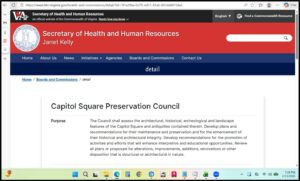
Anyone who feared that the Council could easily be dominated by radicals or partisan politics would have been comforted by the guidelines for selecting council members. The Governor, Speaker of the House and Delegates and Senate Committee on Rules had to choose members from candidates nominated by specific groups. What groups, exactly? MoveOn.Org? Code Pink? The United Daughters of the Confederacy? The Virginia Flaggers?
No. These groups: the Garden Club of Virginia, the Historic Richmond Foundation, the Association for the Preservation of Virginia Antiquities, the Virginia Society of the American Institute of Architects, the Virginia Museum of Fine Arts, the Virginia Chapter of the American Society of Landscape Architects and the Virginia Historical Society, and (last but not least) the Citizens’ Advisory Council on Furnishing and Interpreting the Executive Mansion.
That doesn’t sound like a collection of radicals. That sounds like a list of mainstream, responsible heritage and professional organizations. That list inspired confidence that any decisions to make major changes to the monuments in Capitol Square would receive measured, thoughtful consideration.
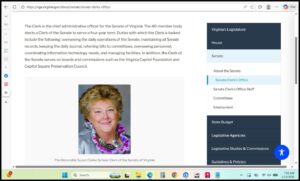
This is a screen capture from the website of the Senate Clerk. Again, note the date — 01/13/26.
Several years ago, the Richmond Free Press acknowledged (indirectly but clearly) that the council did have a recognized role in matters concerning statues on the capitol grounds. When Democrats removed Confederate statues from the capitol building in 2020, Republicans accused them of usurping the council’s authority. The Free Press’s Jeremy Lazarus corrected them. “The preservation council,” he wrote, “focuses on statues on the grounds of the Capitol, not items inside.”
So, what happened to the Capitol Square Preservation Council? That’s a good question — because it’s gone!
The Virginia Council is a conservative-leaning group of heritage activists. One of its members, Dr. Ann McLean, reached out to the council in early January, to ask if there were any proposals under consideration to move the Jackson statue. To her surprise, executive branch employees told her that the Council had been disbanded last year.
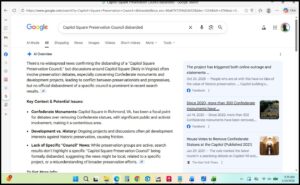
Someone forgot to tell that to Google. (And the webmaster for the Secretary of HHR and the Senate Clerk). If, on January 13th 2026, you Googled “Capitol Square Preservation Council,” you got a lot of search results that made you think the council was still in business.

If you Googled “Capitol Square Preservation Council Disbanded,” Google’s AI agent told you this: “There is no widespread news concerning the disbanding of a ‘Capitol Square Preservation Council’…no official disbandment of a specific council is prominent in recent search results.”
So, how does a non-partisan council, which is — sorry, was — supposedly created to ensure that historical symbols are — sorry again, were — handled thoughtfully and carefully, AND is mentioned in the Virginia Code, just disappear? Wasn’t somebody in Richmond supposed to tell the rest of us? Now, who is going to review, with thought and care, plans for altering or removing monuments on Capitol Square?
“A vital protection from the vile movement that seeks to destroy important elements of Virginia’s past has been erased,” said Will McGurn, director of the Virginia Council, on January 18th.
“The Virginia Council has learned that the Capitol Square Preservation Council has been effectively ‘disbanded’ according to Karen La Forge, Executive Director of the Virginia Capitol Foundation. … “The Preservation Council was stripped of its funding and personnel by the 2025 Virginia state budget bill (Acts of Assembly Chapter 725, approved May 2, 2025) and states that the Capitol Square Preservation Council is no longer in operation.”
McGurn’s criticisms crossed party lines. “Governor Youngkin abandoned this public safeguard for ‘the architectural, historical, archeological, and landscape features of Capitol Square and antiquities’”, he wrote. “No notice, no warning, no explanation.”
The Council was, essentially, an insurance policy. A policy the people of Virginia, through their elected representatives, had taken out to protect symbols of the Commonwealth’s heritage from rash actions that don’t represent the public will. When someone cancels your insurance policy, they’re supposed to tell you.
Public servants have a duty to communicate, clearly, with the public they serve. Otherwise, the public might easily lose faith in government and its institutions. If you disband an important public commission, and Google doesn’t know you did it, you’re not communicating clearly.
Donald Smith is a graduate of the University of Virginia. Raised in Chesterfield County, his mother was born in a log cabin outside of Lexington, which her grandfather built after the Civil War. The cabin, now restored, is still occupied by family members.
Orignally published on the Bacon’s Rebellion