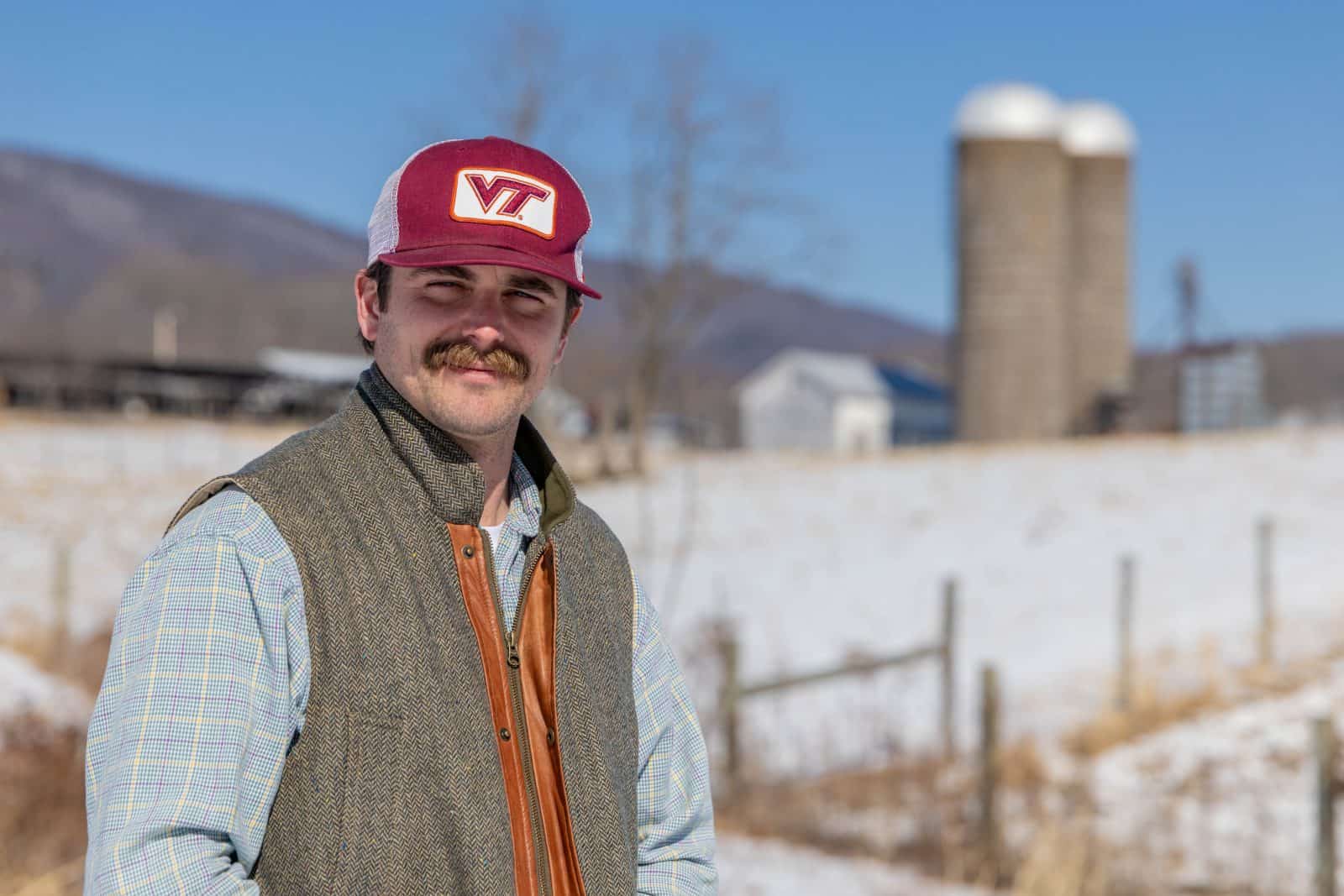
When Matthew Wagner walks the fields of the Catawba Sustainability Center, he’s thinking about more than daily farm work. Located about a half hour northeast of Blacksburg, the 377-acre Virginia Tech center supports faculty research, student learning, and partnerships with producers and community members across the region.
The center’s farm manager role sits at the intersection of land stewardship, research support, and community engagement. Matthew Wagner recently stepped into the position. In partnership with Roanoke County, the center serves as a living laboratory for sustainable agriculture, regenerative grazing, agroforestry, and applied research benefiting producers across Southwest Virginia and beyond.
“Catawba has incredible potential as a place where students, faculty, farmers, and other community members can learn from one another and work together,” Wagner said. “My goal is to provide the infrastructure, coordination, and day-to-day support they need to ask meaningful questions and test real-world solutions.”
Wagner’s path to agriculture was unconventional. After studying photography at the Maryland Institute College of Art, he gravitated toward hands-on agricultural work — from greenhouse production and farmers markets to livestock operations and small-scale research trials. The experience gave him a systems-level understanding of how food production, stewardship, and community connect.
“I wanted to understand agriculture from as many angles as possible,” Wagner said. “That meant getting comfortable doing the work, asking questions, and learning from people who’ve been doing it for decades.”
That breadth of experience now serves him well at the Catawba Sustainability Center, part of Outreach and International Affairs. Before becoming farm manager, Wagner worked at the center as an agricultural technician, supporting faculty research projects and contributing to the Grass-Fed Beef Partnership. He helped implement adaptive multi-paddock grazing practices and monitor forage health, while building strong relationships with faculty, students, and community partners who rely on the center as a place to learn, conduct research, and collaborate.
“Matthew understands that the center must be both operationally sound and academically responsive,” said Susan E. Short, senior vice president for outreach and international affairs. “He brings hands-on agricultural experience, curiosity, and organizational skills that will help sustain and strengthen the center’s role as a hub for regenerative agriculture research.”
At its core, the Catawba Sustainability Center exists to support research and engagement that extend far beyond the farm’s fences. Supporting faculty and student research remains central to that mission. Wagner collaborates with faculty to ensure experimental plots, grazing systems, and data collection align with research needs, while facilitating interdisciplinary projects spanning agriculture, environmental science, and community engagement.
Research, training, and partnership in action
A former dairy farm that once supplied Catawba Hospital, the property became part of Virginia Tech in 1988 and operates today through a partnership with Roanoke County. Its evolution from working farm to living laboratory reflects the university’s land-grant mission, with ongoing collaboration through Virginia Cooperative Extension.
The center’s focus on regenerative practices — including soil health, agroforestry, and sustainable livestock systems — makes it a hub for applied research with real-world relevance. Wagner sees his role as helping ensure the farm continues to support that work.
“If a faculty member has an idea, I want the first answer to be, ‘Yes,’ followed by, ‘How do we make this work?’” Wagner said. “That might mean adjusting grazing rotations, coordinating equipment, or helping design systems that support their goals.”
John Fike, forage Extension specialist and professor in the School of Plant and Environmental Sciences, works with an interdisciplinary group of crop, livestock, and forest scientists on silvopasture management — a grazing system that integrates livestock, trees, and forage.
“The Catawba Sustainability Center gives us a place to teach, test ideas, and engage producers in a real working setting,” Fike said. “The center is also a jewel for training agency personnel — from the Virginia Department of Forestry to Natural Resources Conservation Service professionals — as well as private groups interested in conservation and regenerative agriculture.”
Wagner is committed to ensuring the center remains a welcoming and accessible resource for students, researchers, producers, and the broader community. He supports tours, field days, hands-on learning experiences, and workshops, including a series of grazing workshops led by Virginia Tech faculty and other experts.
“Catawba belongs to a lot of people — researchers, students, producers, and community members,” Wagner said. “My responsibility is to care for the land and the operation in a way that earns trust and supports the university’s land-grant mission.”
By Diane Deffenbaugh