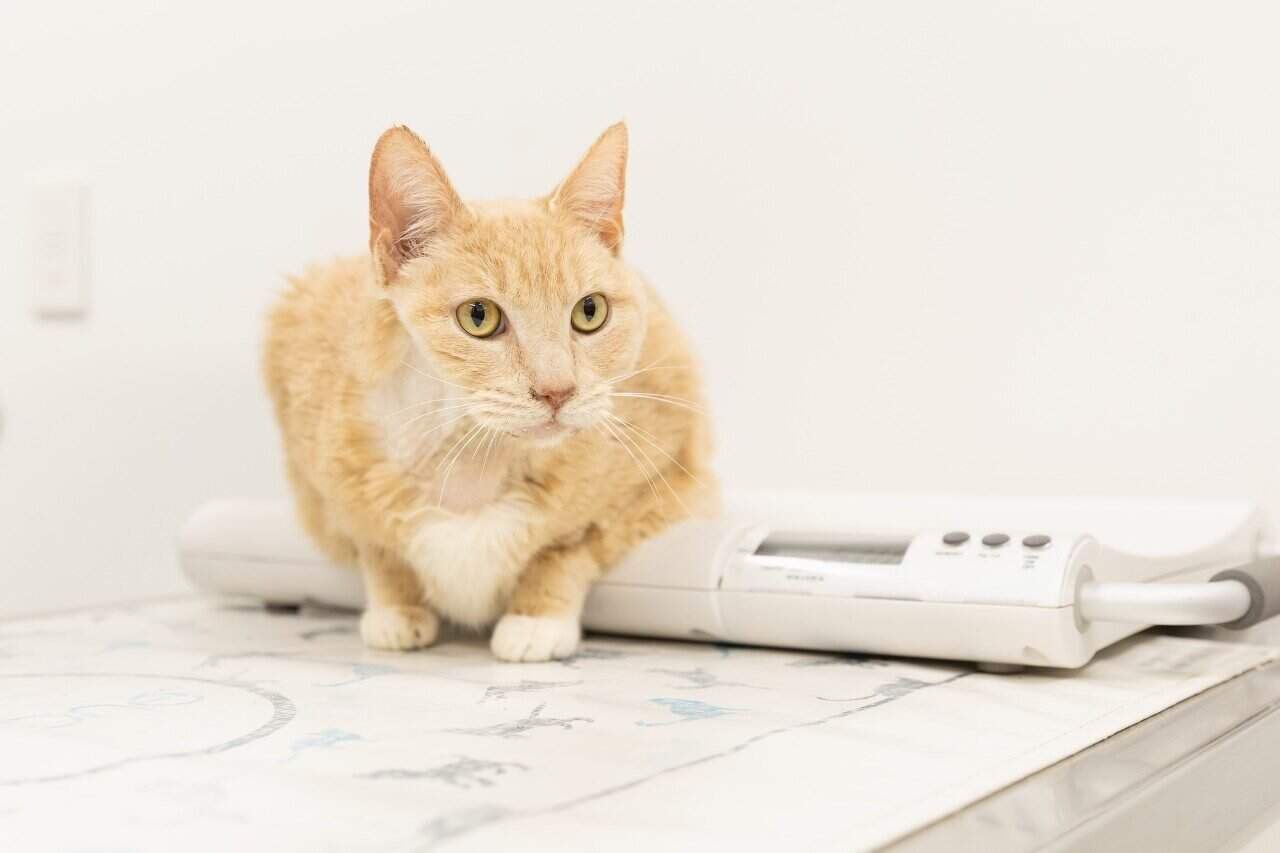
Cynthia Sutton drives 3 ½ hours every three weeks from Big Stone Gap to Roanoke to see that Piggy, her 6-year-old tabby cat, gets the best cancer care available at the Animal Cancer Care and Research Center.
And her commitment has been rewarded: Piggy is in clinical remission from lymphoblastic lymphoma nearing the end of a treatment regimen that has included both chemotherapy and an exploratory radiation approach.
“They are wonderful here,” Sutton said of the cancer center, one of three teaching hospitals of the Virginia-Maryland College of Veterinary Medicine. “They are always nice, even when I’m here late, because I have to travel three and a half hours from home. As long as he has his treatment, that’s what matters.”
Petco Love support
The treatments can be expensive, running many thousands of dollars, on top of the travel costs and time commitments. That’s where national nonprofit organization Petco Love has stepped in to support Sutton’s commitment and Piggy’s needs.
Petco Love is committed to supporting treatment for pets fighting cancer, furthering pet cancer research, and raising awareness about early detection of pet cancer.
Partnering with Blue Buffalo, Petco Love provides the Animal Cancer Care and Research Center with lifesaving investments each year to partially or fully cover costs for those who have difficulty affording cancer treatment for their pets.
Challenging journey
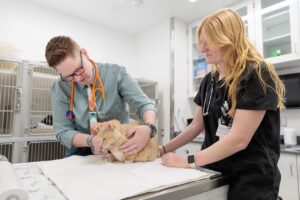
Clinicians knew early on that Piggy’s path would be steeply uphill, as he came in to the cancer center, located in Virginia Tech’s Health Sciences and Technology campus in Roanoke, with a large growth on his face and neck.
“He had the history of the enlarged node,” said Jonel Nightingale, hospitalist at the cancer center and an assistant professor of practice in medical oncology at Virginia Tech. “We had a biopsy done, it found lymphoma, but we didn’t know if it was just located there. So when we did diagnostics, it turned out that there were a few other lymph nodes in the body that were enlarged, and one of his kidneys was affected.”
Late last year, Piggy began a multi-agent chemotherapy regimen. The cancerous mass decreased by about 80 percent after the first treatment.
But cancer center clinicians realized early on they needed something more to give Piggy a real chance to beat back lymphoma.
“Piggy’s mom was incredibly committed to his care and wanted to do everything possible for him,” said Beatrix Manning, chief medical officer at the cancer center and a clinical assistant professor of radiation oncology. “Because of this dedication, we discussed findings from recent studies suggesting that adding half-body irradiation therapy to chemotherapy may significantly improve outcomes, with some canine studies showing a potential doubling of survival time.
Encouraging results
Half-body irradiation can be particularly beneficial in lymphoma, Manning said, because, although chemotherapy treats cancer systemically, radiation is extremely effective at killing lymphoma cells.
By delivering low-dose radiation to large regions of the body, half-body radiation can help eliminate microscopic disease that may persist despite chemotherapy. Treating the body in two halves also allows healthy bone marrow in the untreated half to recover between treatments, reducing the risk of significant side effects compared with total body irradiation.
Piggy received the two radiation treatments two weeks apart, exhibiting no notable side effects.
“Traditionally, most dogs and cats with lymphoma are treated with chemotherapy alone, and radiation therapy is not routinely incorporated into the treatment protocol except for localized disease,” Manning said. She said recent studies showing “encouraging results” in dogs treated by half-body radiation are a rationale for trying the same approach in other species.
“However, there are currently no established studies evaluating half-body irradiation in cats with lymphoma in the same clinical context,” Manning said. “For that reason, using half-body irradiation in Piggy represents an exploratory or extrapolated approach based on the canine data. The goal was to determine whether cats might experience similar benefits from the addition of radiation therapy to standard lymphoma treatment.”

Clinical remission
Continuing with his chemotherapy treatments after receiving radiation, Piggy’s condition showed marked improvement.
“At this point we would say that he has clinical remission,” said Nightingale. “There is no detectable evidence of lymphoma. His kidney values have returned to normal. All of the nodes on the outside of the body are normal.”
“When they came and said ‘clinical remission,’ that was awesome!” Sutton said.
Soon, Sutton will not have to make the 200-mile drive to Roanoke as often. Piggy’s prognosis is excellent, but every cancer case involves vigilance, as lymphoma often does return, and Piggy’s condition will be closely monitored.
“Nearly five months after beginning treatment, Piggy remains in clinical remission,” said Manning. “His story highlights how a comprehensive cancer care center — where specialists in different areas of oncology work together — can create thoughtful, individualized treatment plans that offer patients the best chance for a positive outcome.”
By Kevin Myatt