We were invited to join some geologist-birder friends for an outing last week that would carry me farther north in the state than I have been, now into my second year in Missouri.
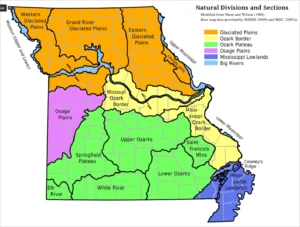
So just when I think I know what the lay of the land (in my county of residence) is like, I am transported not so many miles north of the city of Columbia (in the yellow Ozark border counties) into the (orange) land left behind by the last southern advance of the final period of glaciation before the current era.
And just for comparison, our tour guides stopped and let us stand in the flattest patch of Earth I have ever witnessed—out of a history exclusively Appalachian and far south of anywhere a mile of ice had ever been.
The division line was distinct and we were upon the boundary suddenly, driving back south over the orange-yellow border, to arrive at the miscanthanus field which was our destination.
I only knew the plant as a cultivar—what we called Silver Plume Grass—growing just off the porch in our final Virginia home setting. But it is planted intentionally (and escapes cultivation) on large tracks of land across several continents:
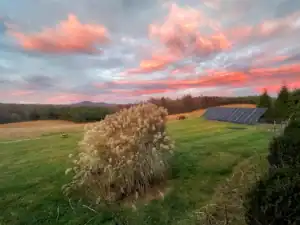
Wikipedia gives a summary:
Miscanthus’ ability to grow on marginal land and in relatively cold weather conditions, its rapid CO2 absorption, its significant carbon sequestration, and its high yield make it a favorite choice as a biofuel.[10][11]
Miscanthus is mainly used for heat and power,[12] but can also be used as input for ethanol production (if harvested wet). If harvested dry, it can be burnt directly in biomass boilers, or processed further (pellets, briquettes). It can also be used as a “green” building material, for both wall construction and as general insulation.
An experimental house based on Miscanthus straw bales was built in 2017.[13] Miscanthus cropping enhances nutrient cycling in the plant–soil system.[14] In a 2025 research dried stems of Miscanthus giganteus, together with other materials, were used to create a biobased concrete substitute called Xiriton, which offers a low-carbon, eco-friendly material that can support shellfish settlement and salt-marsh restoration.[15]
Wetland Birds Making Do
In the present circumstance as we stood at the edge of our destination miscanthus field, it was the bird population we expected to plunge into this tall grass that was the reason for our travel north of town.
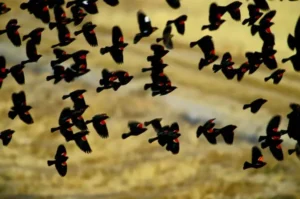
The field is no longer harvested as a biofuel but persists as winter roosting for enormous numbers of blackbirds. We stood in the cold and waited for them to converge and dive in to roost for the night.
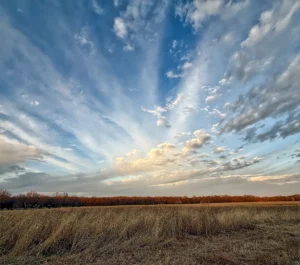
We are talking literally millions of black birds—mostly redwings. This phenomenon certainly is known by the local farmers, who see them as pests when they roost to close to homes. But birders by and large have not known about—and seemingly are not much interested—in these common birds, even in such impressive numbers.
But why these birds in these fields of this tall tough grass?
The thinking is that, as birds who prefer and evolved in reedy marshes of rushes, reeds and cattails, they are out of luck in modern human times where former prairie wetlands have been drained. What comes close is this tall sturdy grass. A half-dozen birds will roost vertically stacked on a single plant—the most cattail-like perch they can find.
For an hour before they finally converged on our field in view, we saw barely visible in the distance “rivers” of birds stretching literally miles across the sunset skies, just above the tree line.
I am disgusted with myself that I did not come home with stills of the scene, so a screenshot from a video will have to suffice. The experience is hard to convey; you had to be there.
Yes, it was a visual marvel; but I remember, too, the sound of a million birds moving in waves, surging east and west in restless masses, unsettled and searching, flowing like a poured substance made of legions—individual birds following the will of one discrete phalanx and not another; united by what—family groups? Socially-bound or habit-bound aggregates?
If you closed your eyes, you heard the sound of the beach, ebb and flow, as wave after wave surged onto the shore of tall grass moving with the wingbeats of so many individual birds given over to the will of the whole.
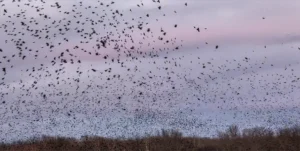
And they never stopped chattering—on the wing, circling and settled—they used up so much hard-won fuel in their seeming random coursing back and forth, calling to each other the whole time, saying: what? It must be important and necessary, but it is a mystery beyond the brains of birds.
Little work has been done, and dozens of interesting questions are open for exploration. Where do these birds feed and why do they forage so far from their nighttime roosts in the miscanthus? Where do they spend the summers and are the same birds returning year after year to this particular location?
And so I have expanded my own home range beyond the bounds of Boone County, thanks to my peripatetic friends. I have seen far more birds in one hour than the sum total of every bird I’ve observed over a long lifetime.
And I am amazed at how life goes on in divers ways, with every single make and model of living thing obeying its own rules and urges, earning a living, getting by—hardwired and willing to survive, one among the many.
 – Fred First is an author, naturalist, photographer watching Nature under siege since the first Earth Day. Cautiously hopeful. Writing to think it through. Thanks for joining me. Subscribe to My Substack HERE.