Full disclosure: One, I am not a climatologist. Two, I understand the difference between weather (short-term conditions) vs. climate (long-term trends).
But just as an observer, it’s been really cold here around Roanoke for a long time. On Saturday, January 24, it began to snow, and during the night it turned to sleet.
(That was actually a huge blessing for us, since sleet bounces off, so most of us kept our power on. Many areas south of us, even in the Deep South of Mississippi and Alabama, had freezing rain which accumulates, gets heavy, and thus brings down trees and power lines with it.)
Then, on Sunday and Monday, bitter cold came in, turning that top layer of sleet into solid sheets of ice some four to five inches thick. In our area, we can usually just shovel off the snow or, better yet, wait a day or two for the sun to come out and the temperatures to get above freezing to do the snow removal for us.
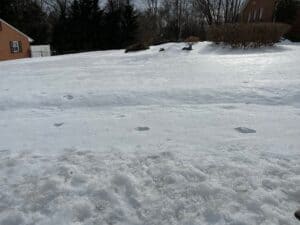
But this time, the arctic blast was both brutal and huge. Much of Florida, Texas, and elsewhere in the Deep South shivered in the 30s that week, and a town on the north coast of Cuba broke a record by getting down to literally freezing, 32!
By Monday here in our area, the sheets of ice were more like concrete. Snow shovels were basically useless; one had to try to break through the ice with metal picks or something, or else find someone with a vehicle and a blade to break up the ice blocks.
A friend of mine who grew up in this area said that never in his 82 years has he seen an ice storm like this. One Bedford County resident on social media reported her husband had to go buy a flamethrower to melt the ice on their driveway!
My plan on Monday to “shovel the walkway and driveway” quickly hit reality: there was no “shoveling.” Instead, I had to triage my efforts to use my shovel blade as a kind of pickaxe to just chip blocks of ice around my car so I could get out, and then call it a day.
For days, I could walk across the ice in my yard and never break through, even when standing on one leg and putting all my 190-pounds-plus on an area the size of one foot. Well, specifically, I could walk across the completely flat parts of my yard. Where there was any slope at all, the risk of sliding and falling was treacherous.
It may sound silly, but on that next Friday, about one week after the storm, I had to put some checks in the mailbox, so I gripped a rope our oldest son had tied to a tree and, holding on to it, slowly worked my way down the grade to the mailbox and then back up again.
As I recall, the Roanoke Valley had a solid nine days below freezing, so virtually nothing melted.
About ten days after the storm, I spoke with a friend near Nashville. He said his house lost electricity for about four days, but that many in and around the Music City still were without power!
As I write this on Saturday, February 7, Day 14 after the storm began, most of our area is still clad in white. If you didn’t know better, to look at the covered fields and yards, you’d think the snow fell yesterday. It’s now 14 degrees, with a wind chill between zero and 1.
Thankfully, by Monday it’s supposed to be 40, then 50 on Wednesday, but that will be a full two and a half weeks after the storm.
I’m simply asking the honest question. If “Global Warming” is real, how is all this possible?
A few years ago, my wife and I were flying to Florida, and I noticed the man next to me had a friendly countenance, so we struck up a conversation. It turned out he worked for the National Oceanic and Atmospheric Administration (NOAA), and he actually was a climatologist. I decided to take a risk and ask him his thoughts on “global warming,” and he said that, of course, climates and weather patterns change all the time, but no, he didn’t believe the world was actually getting hotter.
I asked him if he had to keep those views on the downlow at his job, and he chuckled and said yes, he had to.
Granted, many winters here in Roanoke are mild, with little to no snow. But that’s certainly not the case now.
It’s abundant coal and natural gas that have kept the juice on for lots of us Virginians, and the Democrats’ war on fossil fuels will result in higher costs for electricity and, like a domino effect, most everything else. Plus, lots of the solar panels and accoutrements for “green energy” are made in China, so you’ve got that China Communist Party (CCP) angle at work too.
In the early 2000s, when much of the US and Europe had some mild winters, I recall reading a story from the British media predicting, paraphrased: “someday soon, snow in England will be a thing of the past. Children will grow up never having made a snowman, having a snowball fight, or even knowing what snow looks like.”
Just now, in a 2019 article on worldatlas.com while researching for this column, I found this nugget: “In recent years, however, England has been experiencing more and more snowfall.”
There’s much said about divisiveness and rancor in America nowadays, but something most of us, regardless of political persuasion, will probably agree on: it will feel great if the mercury hits 60 on Wednesday!
— Scott Dreyer