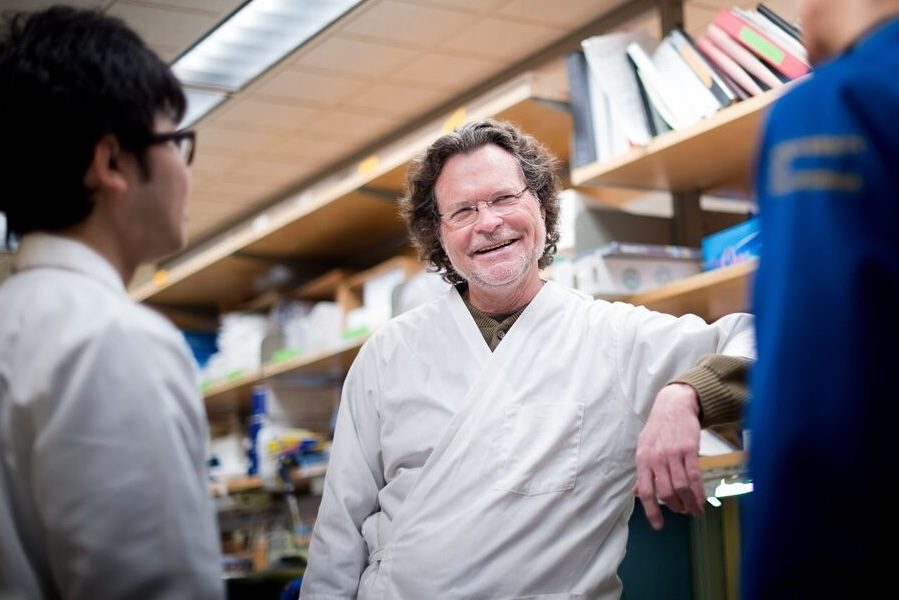
Lewis Lanier ’75 was an undergraduate at Virginia Tech when he took the virology class with Robert C. Bates that would change his career path.
“I can still remember the sunshine coming in the room and him lecturing that day,” Lanier said in an interview with the American Association of Immunologists. “And what he told us in that lecture was if you take an adult mouse and infect it with this virus, the mouse becomes sick and paralyzed.
“But if you inject that same virus into a newborn baby mouse, everything is fine. The virus infects the mouse for life, but it never causes any damage.”
It was a life-changing realization. Lanier had been set on becoming a microbiologist. But that quirk of virology — the ability to introduce a virus and induce tolerance to its effects — caught his attention. And it has kept his attention for nearly 50 years.
Lanier will deliver the next Maury Strauss Distinguished Public Lecture at 5 p.m. Thursday, April 16, at the Fralin Biomedical Research Institute at VTC in Roanoke. His talk, “Immune Recognition of Viruses and Cancer – A Five-Decade Quest,” will outline a key discovery of how an immune cell type recognizes threats and how those discoveries are revolutionizing cancer treatment.
“Essentially, 99 percent of what we know about immunology has been discovered since I was an undergraduate,” Lanier said in an interview published by the University of California, San Francisco, where he is a professor and chair emeritus of the Department of Microbiology and Immunology.
“Dr. Lanier is internationally recognized for discovering how natural killer cells in our immune system detect and fight cancer, laying the groundwork for modern immunotherapy treatments,” said Michael Friedlander, executive director of the Fralin Biomedical Research Institute at VTC and vice president of health sciences and technology at Virginia Tech. “This is an opportunity for our community to hear from one of our own colleagues at the forefront of cancer research whose work has expanded how we understand the disease and might better treat it.”
By the late 1970s and early 1980s, immunology — the study of how the body detects and defends against infection — was expanding rapidly. Scientists had only recently made key discoveries that would shape the field, including how to create monoclonal antibodies, how T cells recognize and attack infected and abnormal cells, and the first identification of natural killer cells.
In 1983, when natural killer cells were still considered a subset of T cells, Lanier published his first paper identifying them by their expression of the CD16 Fc receptor, a surface receptor that binds antibodies.
Most immunology researchers had yet to fully accept that natural killer cells were a distinct cell type.
Lanier had to convince them otherwise. Nearly 50 years later, he estimates that more than 30 biotech companies are focused on natural killer cell therapies.
“To watch my team go from curing mice by treating them with antibodies in 1975, to seeing it work in people, the last 40 years has been the golden age of immunology,” Lanier said.
Natural killer cells are being engineered to attack brain tumors, hepatitis B, cytomegalovirus, and cancers that have learned to evade T cell surveillance.
“Right now, we only cure about 20 percent of those who receive therapies. The question now is, how do we raise that to 80 percent or 90 percent?” Lanier said. “With the amount of energy and money put into the field, I’m sure it will only make it better.”
Lanier was elected to the National Academy of Sciences in 2010, the American Academy of Arts and Sciences in 2011, and served as president of the American Association of Immunologists from 2006-07. He was inducted into Virginia Tech’s College of Science Hall of Distinction in 2023 and is a member of the university’s Legacy Society.
The lecture is free and open to the public, with a reception at 5 p.m. and presentation at 5:30 p.m. on Thursday, April 16, at the Fralin Biomedical Research Institute at 2 Riverside Circle in Roanoke. It will also be livestreamed.
The lecture series is named for Maury Strauss, a Roanoke philanthropist and businessman who supported biomedical research with the goal of energizing the local economy and improving quality of life.
By Lena Ayuk