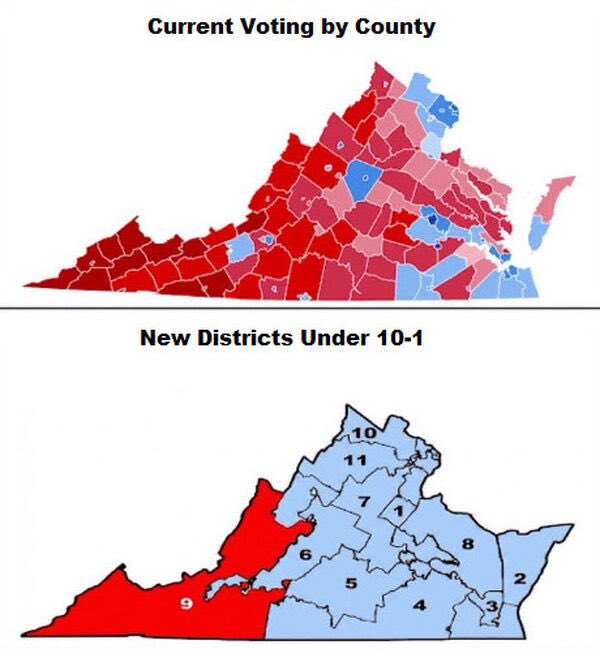
With the final day of voting, April 21, approaching, more Virginians are paying attention to the current election. Many are puzzled or even enraged by some of the following questions:
- Why is an election being held in March and April?
- Why does the ballot offer the voter no names from which to choose, only a simple “yes” or “no”?
- Why does the actual wording on the ballot state that a “yes” vote is “to restore fairness,” as if a “no” vote is for unfairness?
- Why did the governor ban all registrars and polling places across the state from displaying clear maps that a “yes” vote would create?
In addition to the above, there is no agreement on what to call the current election. Supporters, who are pushing for a “yes” vote, call it “the redistricting election.”
In contrast, opponents, who are pushing for a “no” vote, call it “the gerrymandering election.”
In this February 10, 2026, article, The Roanoke Star was pointing out that the “yes” position, with its massive media blitzkrieg, would create “the most aggressive gerrymander of any state,” a direct quote from a February 5 Cardinal News report.
Is the accusation “most aggressive gerrymander of any state” true or hyperbole?
Political pundit Chaz Nuttycombe, whose politics tend to favor Democrats, has posted that the accusation is indeed true and offers math formulas to back it up.
Below is a March 16, 2026 Twitter/X post from Chaz Nuttycombe. His profile states: “Executive Director @StateNavigate. State legislative political scientist & election forecaster. @virginia_tech alumnus. Opinions my own.”
Nuttycombe’s post:
“A lot of the anti-DEM gerrymander folks keep saying that the proposed VA congressional map would be the most extreme gerrymander in the country.
“So let’s put that to the test using actual political science.
“The efficiency gap was the standard developed by political scientists during Rucho v. Common Cause (2019). It’s not an entirely perfect measurement, as noted in Keena et al., “Gerrymandering the States,” because it would technically rate the 2010s Maryland gerrymander as a fair map, for example (though it does show the 2010s Wisconsin gerrymander as an egregious gerrymander!). Keena et al. argue that the mean/median difference is sometimes a better practice; however, for example, it shows the VA gerrymander as a fair map. My standard for measuring how extreme a gerrymander is, or whether a map is gerrymandered at all, is pretty much one standard or the other, depending on which makes sense. In this case, the efficiency gap is the best standard.
“Using the 2024 presidential results, we can see in DRA 2020 what the efficiency gap is in the enacted/proposed congressional gerrymanders across the country. The closer to 0, the fairer the map using efficiency gaps.Negative favors DEMs, positive favors GOP. Let’s take a look.
“VA: -24.02%
NC: 22.55%
MO: 17.65%
OH: 15.34%
CA: -14.92%
IL: -14.60%
TX: 14.05%
NM: -13.98%
FL: 11.79%
“So yes, the proposed VA DEM gerrymander would be the most extreme gerrymander in the country. In fact, it would be more extreme than the 2010s WI Gerrymander that Rucho was all about, which has a 19-point efficiency gap. Only North Carolina comes close to being an egregious gerrymander.”
In sum, Nuttycombe uses math to prove that the proposed Virginia gerrymander, as espoused by the “yes” vote, would give the Old Dominion the most gerrymandered congressional district lines in the nation. Specifically, the lines for Virginia are designed to create 10 Democrat seats to only 1 GOP seat, relegated to the southwest corner of the state.
Nuttycombe writes, “the closer to 0, the fairer the map (….).” Thus, with VA at -24.02%, the proposed Virginia maps are veryunfair, in sharp contrast to the advertising deluge from the “vote yes” blitzkrieg claiming they want to “restore fairness.”
The second-most gerrymandered lines are in North Carolina, with a GOP advantage of 22.55.
Interestingly, many who are voting yes claim “it’s because Texas started it,” but Texas is #7 on Nuttycombe’s list, after the Democrat gerrymandered states of California (#5) and Illinois (#6).
Early voting is now underway across the Commonwealth.
– Scott Dreyer