Early voting is ongoing across the Old Dominion for a proposed Constitutional amendment to redraw the lines for Virginia’s eleven Congressional districts. The last day to vote is Tuesday, April 21.
Here are some key points to know.
A judge has ruled that, by Virginia law, the timing of this election is rushed and thus illegal. The State Constitution (art. XII, § 1) bans “snap elections” and seeks to ensure Virginians have time to read and understand new state Constitutional amendments before they are voted on. As reported here, “No proposed amendment can be submitted to voters sooner than 90 DAYS after final passage by the General Assembly. However, in this case, that would allow voting to start no sooner than April 16.” Yet, early voting began statewide on March 6.
Per the Code of Virginia § 24.2-304.04., the proposed lines (as sought by the “vote yes” side) also violate state law on at least four counts.
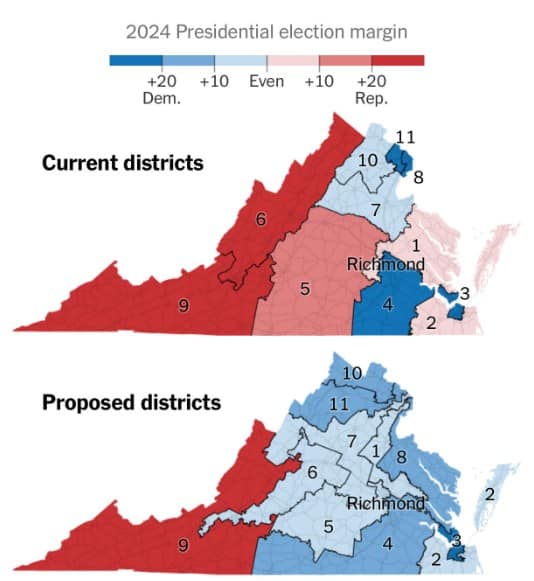
Per Code item 5, the proposed lines are illegal because they do not preserve “communities of interest.” The Code states, “Districts shall be drawn to preserve communities of interest. For purposes of this subdivision, a ‘community of interest’ means a neighborhood or any geographically defined group of people living in an area who share similar social, cultural, and economic interests (….)” For example, the Roanoke Valley and Southwest Virginia are clearly “communities of interest.” However, if the “yes” side wins, the new Sixth District would lump many conservative parts of western Virginia, such as Bedford County, in with liberal college enclaves such as Radford, Virginia Tech, UVA, and JMU. The Shenandoah Valley, now in one district, would be split up among four. Rural Augusta County would be divided among three districts. Here in our region, areas to be splitamong two districts include the Counties of Roanoke, Bedford, Botetourt, and Montgomery, as well as communities including Cave Spring, Glenvar, Blue Ridge, Vinton, and Christiansburg.
All of Botetourt County is slated to be in the new, even more sprawling Ninth District, except for Rainbow Forest, which would be in the blue-leaning Sixth District. Evidently, since Rainbow Forest is on the 460 corridor, it’s a part of the “narrow neck” of Republican neighborhoods in Eastern Roanoke County designed to serve as “connective tissue” to link blue enclaves like Roanoke City and Tech to the west with UVA and JMU to the north.
At its narrowest point, the proposed Sixth District would include only three precincts in east Roanoke County: Orchards, Bonsack, and North Lindenwood. (South Lindenwood, just south of Route 24, would be in the Ninth District.) Thus, North Lindenwood would be lumped in with UVA and JMU, two hours north, while South Lindenwood would be lumped in with Cumberland Gap, on the borders with Kentucky and Tennessee.
The same is true on the west end of the valley. The North Glenvar precinct would be in the blue Sixth District, while South Glenvar would be in the ruby-red Ninth.
Dwanye Yancey in Cardinal News claims Christiansburg is the only town in the whole state set to be split up, and describes its dissection this way: “the point is, the town gets split between congressional districts. This appears to be the first time that Montgomery County has been divided between two congressional districts. The intent with this map is to draw the 6th as a Democratic-leaning district, which requires putting the county’s Democratic precincts (such as Blacksburg) into the 6th and leaving others in the 9th. Christiansburg is politically divided, and the proposed congressional line puts the town’s Democratic precincts in the 6th and its Republican ones in the 9th, a division made with surgical precision.”
Per Code item 6, the proposed lines are illegal because they are not very contiguous. The Code states: “Districts shall be composed of contiguous territory, with no district contiguous only by connections by water running downstream or upriver, and political boundaries may be considered.” The proposed lines violate, if not the letter of the law, then the spirit of the law. For example, the new Sixth District would be like a thin snake along the 81 corridor, connecting liberal Radford University, Virginia Tech, and Roanoke City, while rural areas only minutes away would be lumped into a sprawling Ninth District.
Per Code item 7, the proposed lines are illegal because they are not compact. Again, the Code: “Districts shall be composed of compact territory and shall be drawn employing one or more standard numerical measures of individual and average district compactness, both statewide and district by district.”
The current Ninth District, because it is rural and each House seat is to have about 780,000 residents, is already about the size of New Jersey in area. However, with the new districts, it would get even larger, sprawling from Cumberland Gap up to Highland County, home of the Monterey Maple Sugar Festival. The distance between those two points is 340 miles, or 5 hours and 49 minutes of non-stop driving. In fact, the quickest route between the two, which includes a long stretch on I-81, requires the driver to go through Tennessee for a long distance.
Five of the new districts would each include a slice of two populous, blue Counties…Fairfax and Prince William…but then stretch deep into other parts of the state, including the Shenandoah Valley, Goochland County west of Richmond, and Williamsburg.
Per Code item 8, the proposed lines are illegal because they clearly favor one political party. The Code requires: “A map of districts shall not, when considered on a statewide basis, unduly favor or disfavor any political party.” However, leading Virginia Democrats, including Senate Majority Leader Louise Lucas (D-Portsmouth), broadcast her views on social media last winter, that she desired a 10 Democrat to 1 Republican map, and that’s what the proposed map ended up being.
For example, Virginia’s Fifth District is a sprawling area including much of Southside. It goes from the North Carolina line up to Lynchburg, Charlottesville, and up to the exurbs of Northern Virginia. Since it’s largely rural and includes Liberty University, it has a Republican, pro-life Congressman, John McGuire. However, the new Fifth would be shifted east to include the Democrat-heavy western suburbs of Richmond. That, and by moving Lynchburg and Bedford County to a new Sixth District, aims to flip a Republican seat to Democrat.
To see how the proposed maps would relate to communities of interest, contiguity, compactness, and political favoritism, one can view the two maps below.
One map is here, from the nonpartisan Virginia Public Access Project (VPAP).This map shows dark or light blue or red to indicate the predicted voter performance for that district, based on previous elections. Zoom in to see how local communities are impacted, but the print is faint.
This map from State Navigate also shows the proposed map, but with a twist. It also shows the new boundary lines in black, but also gives shades of red or blue to indicate how individual localities trend. For example, in the new Sixth District, nicknamed “the Hammerhead” due to its odd shape, one can see deep blue at the base of the handle (Radford and Virginia Tech), blue Roanoke City, and blue Albemarle County, around UVA (the actual head of the hammer). A tiny protrusion in the top left goes up just far enough to include JMU in the Sixth District. Because of its unusual shape, placement, and intent to pack more blue voters into what is generally a red part of the state, that JMU protrusion has been called “the middle finger.”
Speaking of maps…
Gov. Spanberger has banned all Virginia registrars and polling places from displaying maps of either the current or proposed lines. Only text can be used to describe the proposed amendment; no visuals.
The Supreme Court of Virginia (SCOVA) has still notruled whether the current election is legal or not. As reported here on February 22, a judge in Tazewell County ruled the election illegal. SCOVA agreed to take the case, but will not hear oral arguments until after voting is over. The Roanoke Star explains this further in this February 16 article, “State Supreme Court Basically Nullifies 2020 Election, Disenfranchises 2,770,489 Virginia Voters.”
This election represents a broken campaign promise by then-candidate Spanberger. This August 25, 2025, article from The Hill quotes Spanberger and her response if she would seek gerrymandering in Virginia, if she won.
“‘Short answer is no,’ Spanberger said about the prospects of redistricting, local outlet 7News reported.
“‘Virginia by constitutional amendment has a new redistricting effort that was put in place and first utilized in the 2021 redistricting,’ she continued.
“‘I’ve been watching with interest what other states are doing, but I have no plans to redistrict Virginia.’
“Spanberger’s campaign confirmed the statement to The Hill.”
In 2020, Spanberger said, “Gerrymandering is detrimental to our democracy. … Opposing gerrymandering should be a bipartisan policy.” Some “vote no” signs now include a photo of the governor and her quote.
This new election is designed to nullify the 2020 election and disenfranchise 2,770,489 voters. Many claim a “yes” vote now is essential to offset Republican gerrymandering in other states. And indeed, states including Texas, North Carolina, and Ohio have recently redrawn maps in order to help GOP chances.
However, in 2020, over 65% of Virginians voted for a Constitutional amendment to ban partisan gerrymandering and instead have lines drawn by members of a balanced, independent commission. Therefore, a successful “yes” vote will overturn all that election and those votes.
Texas did not “start it.” For starters, the term “Gerrymandering” was coined in 1812, and it has long been a political tool to influence the outcome of elections by deciding who is included or excluded from certain boundaries.
The Old Dominion is by no means immune. A Democrat General Assembly once gerrymandered George Allen out of a House of Delegates seat, but Allen got his revenge by later running for and winning races for governor and US senator. On the flip side, a GOP General Assembly in 2001 gerrymandered Roanoke County resident Richard Cranwell out of a seat, even though, as a former Democrat majority leader in the House of Delegates, he had at one time been one of the most powerful politicians in the state.
In 2024…one year before Texas engaged in its gerrymandering… dark blue New York state redrew lines to hurt GOP incumbent Brandon Williams’ re-election chances. Indeed, as planned, Williams lost to the Democrat.
Addressing long-term Democrat gerrymandering, the New York Post pointed out here:
“In Illinois, (…) Democrats represent 14 of 17 districts, or more than 82% of the state.
“Yet Kamala Harris won Illinois last year by fewer than 11 percentage points, 54.4% to 43.5%.
“In New Jersey, where President Donald Trump won 46% of the vote in 2024, the GOP holds just 25% of the congressional seats.
“In Massachusetts, Trump won 36%, but Republicans hold none of the state’s nine seats.
“Trump actually won Nevada, yet Democrats occupy three of its four spots in the House.
“And in California, (…) Trump won over 38% of the vote in the country’s largest state, and Republicans represent only about 17% of its districts.”
Mid-decade redistricting is unusual. Usually, states conduct redistricting after each decade’s new census, so in this case, after 2020. However, President Trump in 2025 called on GOP-led states to create more GOP-leaning seats, so Virginia Democrats retaliated in 2026.
There is a huge money imbalance. As reported here on April 14:
“The data showed more than $64 million has been raised through April 10 by the main Democratic group, Virginians for Fair Elections, with about $20 million being raised for the Republican led Virginia for Fair Maps.
“While millions of dollars have been poured into this special election for the future of Virginia’s congressional districts, questions are being raised as to not only who is funding the campaigns, but more importantly, where the funds are coming from.
“Of the more than $64 million donated to the Democratic campaigns, only 3% of donations came from the state of Virginia, while 88% of those funds came from Washington, D.C.
“Meanwhile, it’s almost the opposite for Republican campaigns, which have only seen a majority of their funds coming from the PACs and organizations within the Commonwealth.”
The wording on the ballot is misleading. It reads as:
“Should the Constitution of Virginia be amended to allow the General Assembly to temporarily adopt new congressional districts to restore fairness in the upcoming elections, while ensuring Virginia’s standard redistricting process resumes for all future redistricting after the 2030 census?”
This wording is one reason Judge Hurley, earlier in 2026, ruled the election illegal. The implication that a “yes” vote will “restore fairness” gives the impression that a “no” vote is for unfairness.
This amendment is proposed as temporary, but Lieutenant Governor Hashmi says it’s not. On her official Twitter/X page on April 8, Hashmi, who was born in India, refused to debate her GOP opponent last year, and is the first Muslim to hold statewide office in a southern state, wrote: “This is about more than one election cycle. It’s about whether we preserve a system that is fair, representative, and responsive (…)
Voting in March and April is unusual. In 2019, Roanoke City Democrats voted to move local elections from May to November, effective 2020, claiming they wanted more voter participation by linking City elections with national ones. One of the main proponents of that was then-Mayor Sherman Lea Sr.
However, seven years after Lea pushed to move elections from spring to November, he was recently photographed at a “vote yes” workshop in Roanoke.
In general, Democrats support “yes,” and Republicans support “no.” However, some prominent Democrats support “no,” including former State Senator Chap Peterson, who wrote, “We Have to Destroy Democracy In Order to Save It!”
Early voting is strong. It’s widely believedthat a main reason for a spring election on a rushed timeline, in order to guarantee a “yes” win, was to reduce voter engagement and information. However, per VPAP, early voting has been strong, nearly as big as in the gubernatorial race in 2025. As of April 15, 2026, 1,099,859 early votes have been received. In contrast, the final total of votes as of November 4, 2025, was 1,485,413.
The “no” side is encouraged by the high turnout so far, especially since the GOP-held districts are leading the state in turnout so far. Also, GOP voters tend to distrust early voting and prefer going to the polls on the actual Election Day.
The vote “yes” side is encouraged by their roughly three-to-one money advantage, and polls show their side has about a 5% lead.
The new amendment will create even fewer competitive districts and safer ones. A major problem with the current House of Representatives is that, of its 435 members, only 20-30 seats nationwide are considered “competitive.” This is due both to gerrymandering and also Americans’ increasing desire to live and work with people of like mind. By putting more Republicans into the Ninth District, it creates an R+71 lopsided area. And with more Republicans in the Ninth, along with other statewide gerrymandering, that gives Democrats an edge, if not a guarantee, in all the other ten seats.
The ballot offers only Yes or NO, with no names to choose from. Unlike most elections, this does not let the voter choose any candidate. It’s only a yes/no vote, for or against the proposed amendment.
The proposal is designed to concentrate more political power in the I-95 corridor and liberal college towns in the western part of the state. Since political power offers only finite slices of “pie,” more power in urban areas and college towns will be at the expense of most of the rest of Virginians, including in rural areas and small towns.
Everyone in Virginia can vote in this election. In this case, the majority rules, so one vote in western Virginia equals one vote in Northern Virginia or any other part of the state.
“Fairfax” has become a verb. A large sign by I-81 in the Shenandoah Valley declares, “Don’t Fairfax My Virginia.” Five of the proposed districts take a slice of Fairfax, with its high population, in order to overwhelm the geographically larger but less populous parts of the district. In a March 17 visit to Montano’s Restaurant in Roanoke, former Attorney General Jason Miyares claimed the new maps would cause five congressmen to live within about twenty miles of each other, in Fairfax. By concentrating so much power in one tiny area, large, rural swaths of the state could be more easily overlooked since their residents would be easily outvoted by densely populated regions outside Washington.
This election involves both state and federal governments. The powers behind this special election and the drawing of the new lines are in the state government that meets in Richmond. However, the new lines for our 11 Congressional Districts affect us at the federal level, since the House of Representatives is a part of the national government that meets in DC.
Dates to vote. Early voting will continue on April 17 and 18. The last day to vote is Tuesday, April 21, from 6 am to 7 pm.Virginia residents can find their polling place, voter registration, etc., at this state-run portal.
Despite the varying numbers of poll results, signs, advertisements, dollars spent, etc., the most crucial number will be that of the Virginians who actually vote by April 21 to make their voices heard.
– Scott Dreyer