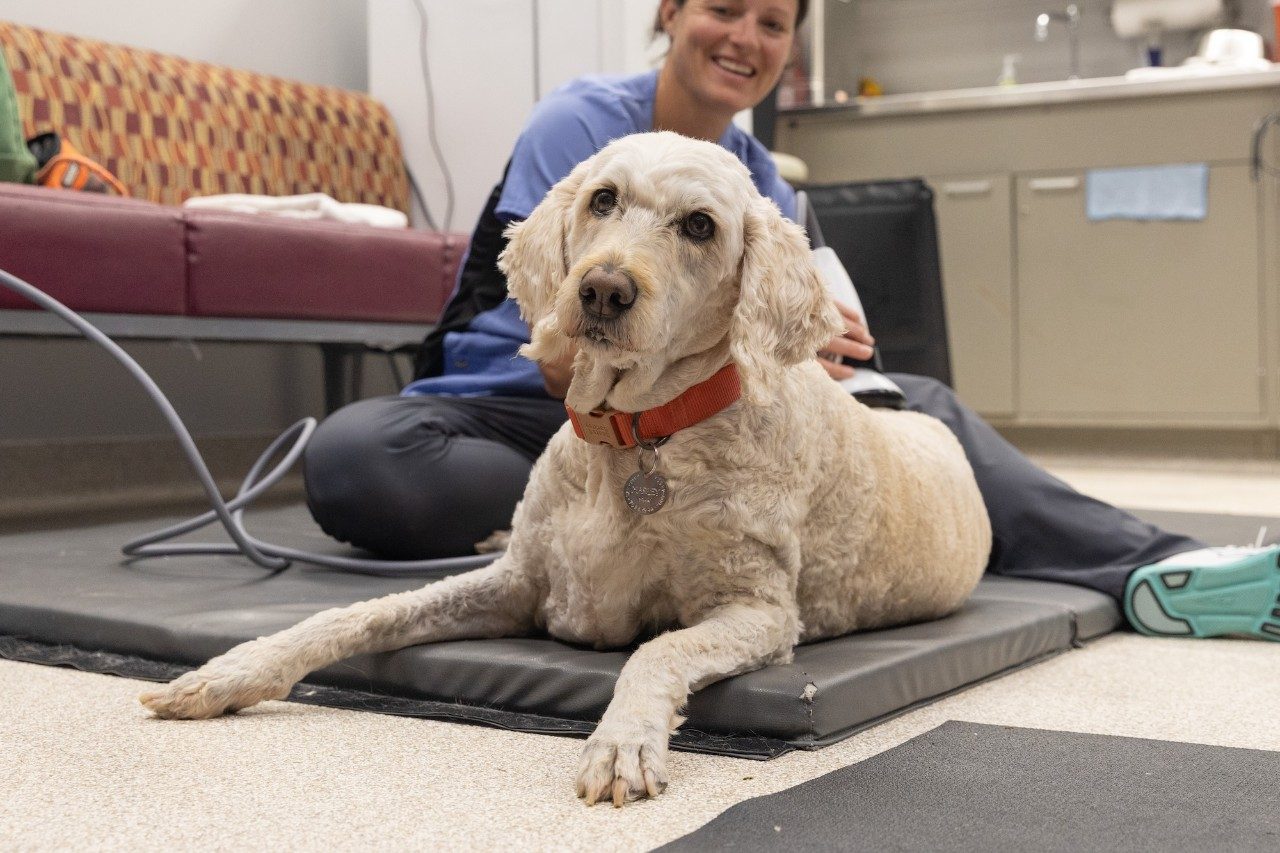
Lindsay Caplan knew something had changed the moment she pulled into the parking lot.
For years, Marley, her 13-year-old golden doodle mix, had been slowing down. The dog who once bounded up mountain trails now struggled with stairs. Morning stiffness had become routine. The outdoor adventures that defined their life together were fading into memory.
But at the Veterinary Teaching Hospital’s rehabilitation clinic, Marley started barking the instant she recognized where they were.
“Marley is terrified of the vet, so I was really blown away that she loves it here so much,” Caplan said. “This is one of her favorite places. We pull into the parking lot, and she starts barking. She comes in here, tail wagging. She is always thrilled to be here.”
That transformation from a dog dreading veterinary visits to one who can’t wait to arrive mirrors a bigger change. After nearly two years of rehabilitation work at the teaching hospital, Marley isn’t just tolerating treatment. She’s thriving.
Shockwave therapy
When Marley first arrived in August 2024, Florence Bliss, assistant professor of practice at the Virginia-Maryland College of Veterinary Medicine who leads the Small Animal Rehabilitation Service, started with the basics — laser therapy, manual techniques, and ground exercises — to help the anxious dog become comfortable with the space and equipment.
The rehabilitation service’s shockwave device, donated by a supporter passionate about senior animal care, uses high-energy, targeted sound waves to penetrate deep into injured tissue. There are several rehabilitation modes that can be used to manage osteoarthritis. Extracorporeal shockwave therapy is unique in that it can reach deeper tissue and target arthritic joints, and it is one of the best treatment options for damaged tendons or ligaments.
“The way that I explain it to clients is that when you have areas of chronic injury or arthritis, it kind of becomes stagnant,” said Bliss, a licensed veterinary technician and certified canine rehabilitation practitioner. “Think about a stagnant pond or stagnant water, there’s no flow through that water, and you just get this build-up of debris and waste material. What shockwave does is wake up that area, and it reminds the body that it needs to pay attention to this area and helps re-boot the healing process.”
The treatment stimulates many cellular responses that aid in healing and regeneration, it decreases pain, speeds healing times and promotes more appropriate and quality healing of bone and tendons. For senior dogs like Marley, it offers something close to regenerative medicine without invasive procedures.
Gradual changes
Caplan, who lives in Roanoke, first noticed Marley struggling about four years ago before she sought help. The changes were gradual: less enthusiasm for hikes, difficulty getting into the car, slipping on the hardwood floors at home. Eventually, it became clear that age-related arthritis was stealing Marley’s mobility — and her joy.
“I have spent so much of my life with her,” Caplan said. “I know that she can’t be here forever, and I just wanted to make sure that as she has given me so much that I could give back to her in those last few years, and make sure that they were as good for her as they possibly could be.”
Marley came home with Caplan when she was just 6 months old. Thirteen years later, they had weathered countless life changes together.
When asked about the dog’s place in their family hierarchy, she offered a telling reply: “Marley is, don’t tell my husband, the love of my life.”
That love brought them to Bliss.
“I’m very upfront with my clients right when they come in,” Bliss said. “I make sure that their expectations and my goals are combined and similar. “
The first shockwave treatment produced only subtle improvements. Caplan noticed Marley’s energy seemed better, but nothing dramatic. By the second and third sessions, everything changed.
“It seemed like with the shockwave, we really had made some huge improvement,” Bliss said. “She really did feel like Marley was acting like a puppy again.”
Signs of progress
Caplan saw the difference at home. The dog who once struggled to rise in the morning now runs to greet her. The stiffness that used to linger through the day has disappeared. And those walks along mountain trails? They’ve stretched to three miles.
“She’s doing so much better on the steps. She has more confidence as well,” Caplan said. “She’s not stiff in the mornings, she gets up, and she runs around. I get home, and she comes out to greet me, and she does zoomies in the yard.”
Between shockwave sessions, Marley continues with underwater treadmill work, therapeutic laser, balance exercises, and other rehabilitation techniques. Caplan follows up with home exercises. The combination has given Marley months of improved quality of life — and counting.
The shockwave benefits lasted about six months before Marley needed another round of treatment. When the second series produced even more improvement, Bliss knew the therapy was working precisely as intended.
“She was saying stuff like, ‘She’s just so energetic. She wants to go on these really long walks. She’s still asking to go on hikes, and just her energy level was amazing,'” Bliss said.
Not for every dog
Not every patient is a candidate for shockwave therapy and keep in mind that there are different models and options for this kind of treatment. The equipment can be loud, can be uncomfortable, and requires trust between the animal and the practitioner. It is still an option for some patients if they can be sedated. Bliss typically introduces it only after a patient has become comfortable during rehabilitation — a process that can take weeks or months.
But for senior dogs whose owners can’t commit to frequent visits, shockwave offers a practical solution: three or four treatments, then months of relief before the next session.
For Caplan, the donor-funded equipment has meant watching her best friend reclaim the life that arthritis was taking away.
Green Hill Park in Salem, with its paved greenway and gentle elevation changes, has become their regular destination. The geese, the other dogs, the simple pleasure of being outside together — all of it possible again.
“The thing that I think has made the most difference as far as what we do in therapy is actually shockwave,” Caplan said. “It was like having a much younger dog back. It was truly, truly incredible.”
Marley, for her part, has developed her own rehabilitation routine. She arrives eager, works through her exercises, and accepts Bliss’s treats — until she decides she wants something better.
“The most ridiculous thing that Marley does is she knows that Flori has plenty of really great treats here, but I also bring her extra treats because she is very particular,” Caplan said. “And so she’ll come in, and she’ll do exercises with Flori and eat her treats, and then she’ll get tired of them, and she will walk over to my bag of treats and just stand there and bark at it until she gets something else to eat.”
“I’m so grateful to Flori,” Caplan said. “She has made such a difference in Marley’s life, and it has just been such a joy to get to come here and hang out with her and know that it really has been such a positive thing.”
By Andrew Mann