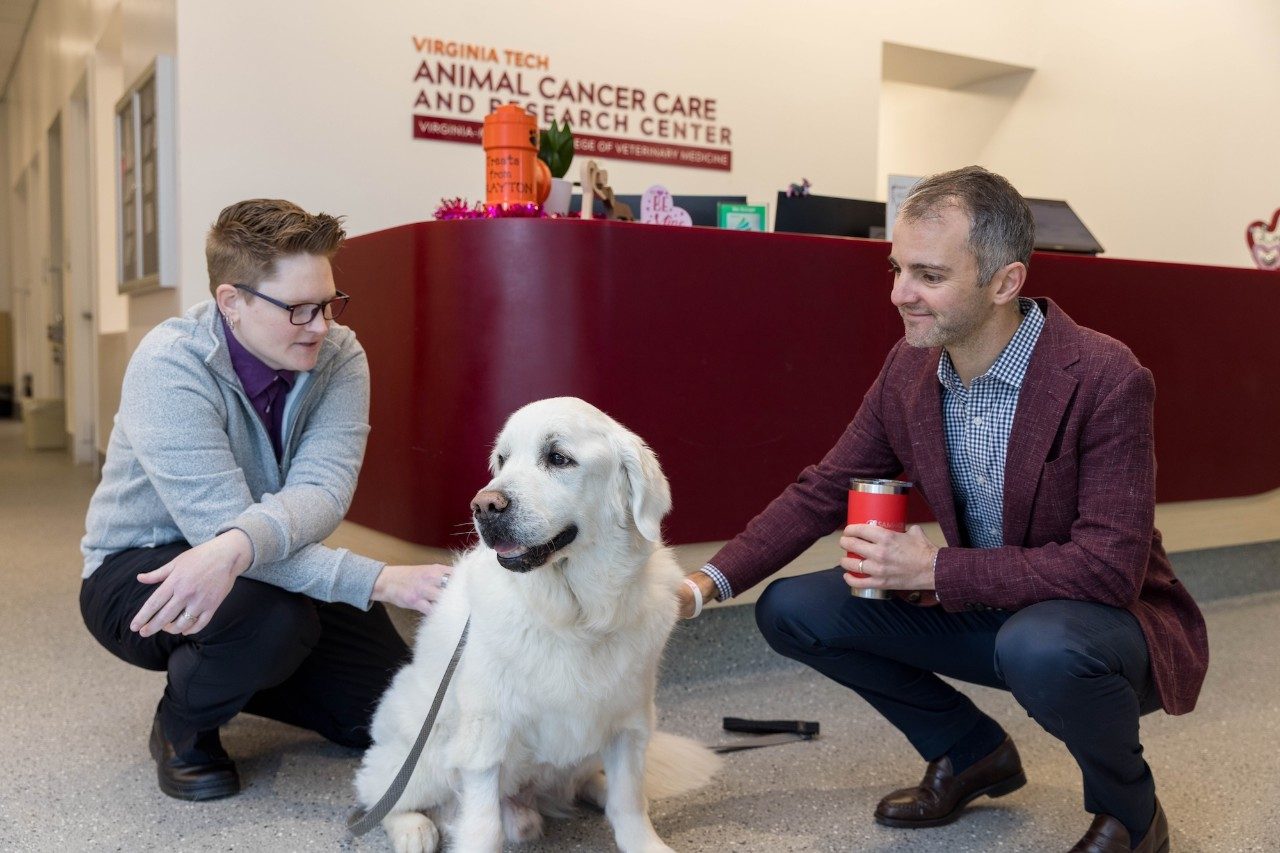
Ragnar gave himself to others in some of their darkest days for most of the last decade. But in this season, it is those around him, including clinicians and staff at the Animal Cancer Care and Research Center, who are giving of themselves to Ragnar as he faces his greatest challenge.
A 9-year-old English golden retriever, Ragnar was nearing time for the October celebration of his retirement as a grief therapy dog for Oakey’s Funeral Service of Roanoke, when one day he stopped eating. Always a voracious eater previously, Ragnar still wasn’t eating the next day.
A visit to veterinarian Thomas Blaszak ’05 DVM ‘09 revealed an enlarged spleen. His spleen was removed, and a biopsy found B-cell lymphoma.
That led to a referral to the animal cancer center, a teaching hospital and translational research center of the Virginia-Maryland College of Veterinary Medicine, located in the Virginia Tech Carilion Health Sciences and Technology Campus at Roanoke.
Chemotherapy began on Ragnar’s first visit in October, and three months later, much of his vaunted energy and liveliness have been restored.
“Virginia Tech has raised him from the dead,” said Sam Oakey IV, who cares for Ragnar with his wife Allison in their home. “Honestly, he was there. There were a couple of times when I didn’t know if he would last through the week before we started the treatments at the cancer center. And then they have raised him from the dead, essentially, and given us, already, great, high-quality time with Ragnar that we wouldn’t have had.”
Tough road ahead
While Ragnar has returned to enough of his old self that he participated in the Drumstick Dash, a charity race through the streets of Roanoke on Thanksgiving, the road ahead is still a difficult one.
Jonel Nightingale DVM ’12, hospitalist at the cancer center, said that a reasonable expectation for Ragnar is for eight to 12 months of good quality life, dating from the start of his cancer treatments in October.
B-cell lymphoma, while generally considered more treatable than T-cell lymphoma, is still what clinicians at the cancer center would sometimes call a “liquid cancer.”
“It’s not one that we can do a CT scan, target it, surgically remove it, and say we’re done” Nightingale said. “Actually, it is very rare for us to accomplish a cure. What we can do is beat it back. We can use chemotherapy to make the lymph nodes shrink, to make the dog feel better, and to slow the progression, because it can spread everywhere. It can start in a node and then end up in the bones or the nervous system. Chemotherapy is designed to slow it down, and, generally speaking, it’s pretty good at it.”
The canine face of Oakey’s
Ragnar has, in many ways, served as the public face of Oakey’s Funeral Service.
“He gets a lot more attention than I do, trust me,” said Sammy Oakey III, president of the funeral service founded by his great-great-grandfather in 1866.
“He worked here for about eight years as a grief therapy dog,” said Sam Oakey IV, who worked alongside Ragnar for seven of those years in the family business. “He would go to people’s loved ones, visitations, funeral services, private family gatherings. He would visit churches, nursing homes. Initially he started out at just funeral-specific events and then it morphed a broad array of places around the valley that he would go and visit with children, elderly, people with special needs, anyone who needed him. All our funeral directors would let families know about Ragnar and the benefits of grief therapy dogs, and we never charged anything for his services.”
While Ragnar is a trained and registered grief therapy dog, Mitzi Oakey, wife of Sammy and mother of Sam, said Ragnar has a gift of empathy that can’t be taught.
“He would go into the rooms and go from person to person,” Mitzi Oakey said. “He would go up to the person who had lost their husband or their wife or their child, and he would put his head on their lap or just lay on their feet, a lot of times he did that. He had the intuition to pick out who needed him the most.”
Complicated case
Clinicians at the animal cancer center used DNA sequencing and artificial intelligence to develop a drug protocol for Ragnar’s chemotherapy treatments.
Nightingale’s role as a hospitalist is to look at the whole patient — coordinating cancer care with oncologists while also identifying and treating other medical issues along the way. Ragnar’s case included several of these challenges.
Early in Ragnar’s care, clinicians discovered that he could not tolerate prednisone, a commonly used anti-inflammatory and immune-suppressing medication in both dogs and humans. The drug left him noticeably sluggish, prompting the team to shift to alternative treatment options.
Further evaluation revealed that Ragnar also has a heart rhythm abnormality, requiring medication to protect his heart before certain chemotherapy drugs could be safely used.
In addition, Ragnar has a torn cranial cruciate ligament — an injury that would typically require surgery on its own, but one that must be managed conservatively while he undergoes cancer treatment.
Ragnar is near the middle of a 25-week chemotherapy regimen. “I think the thing that a lot of people are surprised about is that the chemotherapy in dogs is not nearly as traumatic as it is in humans,” Nightingale said. “Our patients may have a day or two of feeling a bit down after treatment, but the rest of the time they feel like themselves.”
Ragnar’s influence
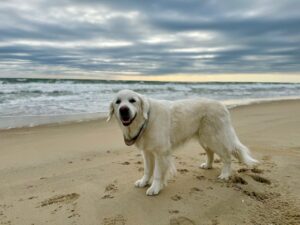
Ragnar has developed quite the fan following.
“He received Christmas cards from people,” the younger Sam Oakey said. “He received tons of recognition in our family response forms that we send out after the conclusion of their time with us, and just became kind of the face of the company. He was just a great ambassador.”
Ragnar has even recruited new talent to Oakey’s.
Kenneth Muse worked in sanitation of the city of Roanoke, but developed a tight bond with Ragnar when he collected the garbage at the funeral home’s offices and central chapel downtown. Oakey’s eventually hired Muse as its supervisor of housekeeping over the funeral service’s five chapels across the Roanoke Valley, and also to help care for Ragnar.
“Ragnar is not only a therapy dog for the people we serve, he’s a therapy dog for me,” Muse said. “I mean, I go through a lot as well. I do, and Ragnar makes my day. And I don’t know what I would do without him. He’s just amazing. I know everybody here loves him, but he and I have a special bond. When he sees me, it just brightens up my day just as much as I brighten up his.”
“When Ragnar was having a bad night a couple weeks ago,” the elder Sammy Oakey said, “Kenny went over to Sam’s house and prayed on Sam’s front porch for Ragnar.”
“And I had to, because I know that prayer changes things,” Muse said. “Ragnar is a fire, man. He’s amazing. He knows we love him, and he knows the end is not here yet. He knows that.”
Returning the love
Ragnar lifts the spirits of those who treat him, Nightingale said. “He’s a rock star patient. You couldn’t ask for a better temperament or sweeter dog.”
And Ragnar and his family think the staff at the cancer center are rock stars as well.
“The support staff is awesome, everyone from the receptionists to the technicians to everyone there, they are very sweet with him,” Sam Oakey said. “He loves them all. He’s happy to visit with them. He’s not scared to go in the building ever. So it’s just a really positive experience going there.”
The people around Ragnar have changed their schedules to spend as much time as possible with their special canine friend as he continues to fight for his life.
“People have pointed out that he spent basically his whole life giving himself to others and focusing on their needs,” Sam Oakey said. “Now, it’s everyone else’s turn to return the favor.”
By Kevin Myatt